Texas Power Switched Bitcoin Miners Off, Then Back On: Difficulty Heads for a 9.3% Rise
The 9.13% difficulty cut of November 14 was bitcoin's biggest since June, and the network is set to claw almost all of it back. The hashrate that went dark was mostly reacting to West Texas electricity prices, and it came back as soon as power got cheap again. Miners' dollar income did not follow, with Glassnode putting hashprice at a record low before the adjustment trims it by another 8.5%.
Bitcoin's mining difficulty is on course to rise 9.3% at block 977,760, according to our node's estimate with 1,906 of the period's 2,016 blocks mined [1]. Since the last adjustment, blocks have arrived every 549 seconds on average, about 9 minutes and 9 seconds, against the 10-minute target [1]. mempool.space lands in the same place, at +9.10% with 110 blocks to go [3]. If the pace holds, difficulty would go from 134.82 trillion to about 147.36 trillion around 02:00 (Madrid time) on November 27 [1].
That would be the largest increase since February 19, when difficulty jumped 14.73% [2]. It is also close to a mirror image of the previous move. On November 14 difficulty fell 9.13%, from 148.36 trillion to 134.82 trillion, the cut we tracked in our piece on the drop and MARA's bitcoin sales [2]. The projected level would leave it just 0.68% below where it stood after the October 29 adjustment [2].
A grid story more than a price story
The result was that power cost more than that machine earned in 45% of West Texas hours during the epoch, up from 9% in the one before [4]. Luxor then separated the two forces. Power prices alone would have pushed the uneconomic share to 39%, accounting for 30 of the 36-point rise, while the lower hashprice alone would have added only 8 points [4]. Texas hosts an estimated 17% of global hashrate, about 180 EH/s by Luxor's count, and switching that off for the extra hours removes around 65 EH/s on average, roughly three-quarters of the 91 EH/s the network lost on a 14-day basis [4].
The cleanest test came over the following weekend. Bitcoin dropped 13%, from $73,900 on November 11 to $64,500 on November 16 [4]. Miners curtailing on price would have kept switching off. Instead, West Texas power eased to between $26 and $43 per megawatt-hour from November 13 to 15, and hashrate climbed back near 1,100 EH/s within a day [4]. The projected 9.3% rise is the protocol catching up with that return.
Back, but not to last year's level
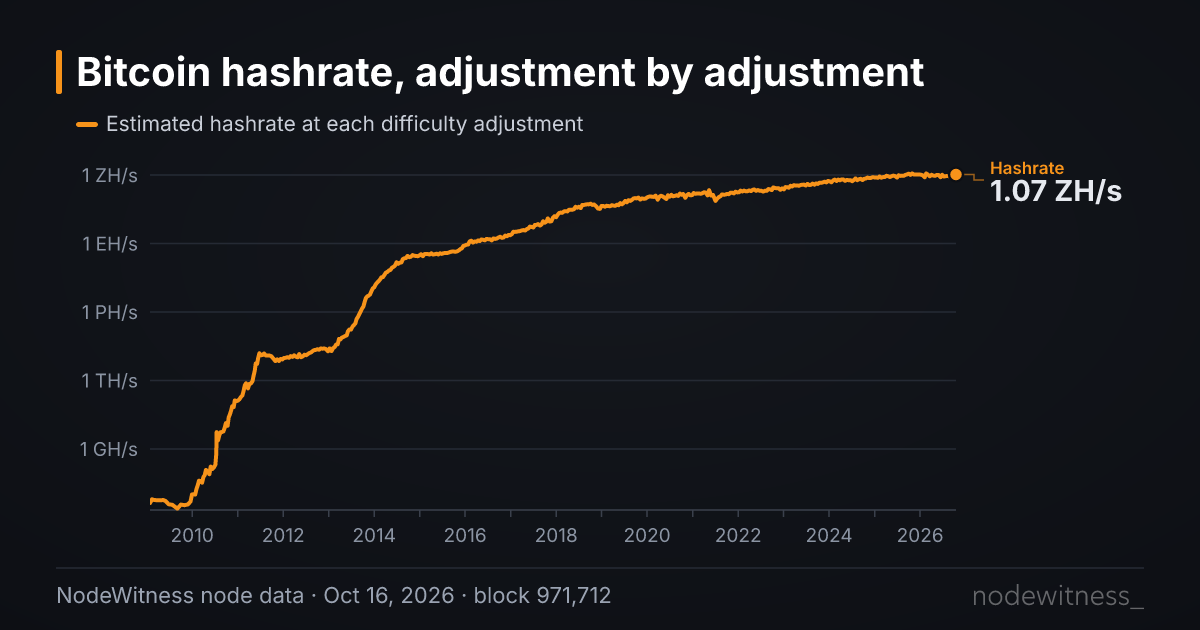
Our node puts the hashrate implied by this period's block pace at about 1,054 EH/s [1]. Hashrate Index had its seven-day average rising from 959 to 1,033 EH/s in the week to November 23 [5]. Single days are too noisy to read on their own. mempool.space's daily estimate was 1,125.9 EH/s on November 24 and 949 EH/s on November 25 [6].
Zooming out to a year tells a different story. On mempool.space's daily series, the 30-day average to November 25 is 1,008.4 EH/s, 6.9% below the 1,082.7 EH/s of the same window in 2025 [6]. That 30-day average peaked at 1,110.5 EH/s on November 12, 2025 [6]. Glassnode measures the annual decline at 8% and says it is the first since China's 2021 mining ban, as reported by crypto.news [7].
Difficulty is in the same position. The all-time high is still the 155.97 trillion set on October 29, 2025, and the projected level would sit 5.5% below it [2]. As of November 26, that is 393 days without a new high, extending the longest such stretch in our node's history, which had already set the record at 377 days when we wrote about it on November 10 [2].
The squeeze on a petahash
Hashprice, the revenue per unit of hashrate, comes down to difficulty, the block reward and the bitcoin price. Over the last 144 blocks, from 977,500 to 977,643, miners collected 452.47 BTC, of which 2.47 BTC was fees, or 0.55% [8]. That works out to 3.1422 BTC per block.
At the difficulty in force, one petahash per second earns about 46,880 satoshis a day, around $28.32 with bitcoin at $60,400 on the NodeWitness ticker [9]. Hashrate Index had 46,850 satoshis and $29.36 on November 23, with bitcoin at $61,606 [5]. If difficulty rises 9.3% and nothing else moves, the same petahash drops to about 42,900 satoshis, 8.5% less, or roughly $25.91.
| Reading | Difficulty | Sats per PH/s per day | $ per PH/s per day | Bitcoin price |
|---|---|---|---|---|
| November 10 reading | 148.36 trillion | ~42,700 | ~31.87 | $74,665 |
| November 26 reading | 134.82 trillion | ~46,880 | ~28.32 | $60,400 |
| After the projected adjustment | ~147.36 trillion | ~42,900 | ~25.91 | $60,400 |
Source: NodeWitness node [1][2], mempool.space average reward [8], NodeWitness ticker price [9] and our November 10 piece. Gross revenue, before electricity, hardware and pool fees.
The table makes the point plainly. After the adjustment a miner earns nearly the same number of satoshis per petahash as in early November, and about 19% fewer dollars, in line with the fall in the bitcoin price. Glassnode says dollar hashprice has hit a record low [7]. Luxor's forward market is pricing an average of $27.08 over the next six months [5]. MARA reported a cost of $30.8 per petahash per day in its third quarter [10]. Its letter does not break down what goes into that metric, so the comparison is rough, but that cost already sits above what a petahash earns with bitcoin near $60,000. We worked through the full cost math in our look at mining costs after Vitalik Buterin's electricity comment.
Reading the estimate
A difficulty estimate is simple proportion. It takes the average block time since the last adjustment and compares it with the 10-minute target, so it sharpens as the adjustment block approaches. With 75% of the period mined, Hashrate Index projected +9.5% on November 23 [5]. At 94.5%, our node shows +9.3% and mempool.space +9.10% [1][3]. In the previous period, our node projected −6.8% four days before the adjustment, which ended at −9.13% [2].
Luxor's Texas analysis has its own limits. It models a single 25 J/TH machine against prices in one zone of the Texas grid, and the 180 EH/s figure for the state is the company's own estimate [4]. It explains why hashrate fell, but it does not say which companies switched off or for how long.
What to watch
About 110 blocks remain, and the final number could land a little above or below 9.3%. Luxor noted that West Texas power topped $120 per megawatt-hour again on November 16, so the next period could see the same swing [4]. With hashprice at record lows, the bigger question is how many miners keep their machines running if bitcoin does not recover.
Follow the countdown on our difficulty adjustment page and the network's power on the hashrate and Hash Ribbons charts. For what a home miner's odds look like at this difficulty, see our solo mining piece. More network coverage lives in the network section.
Sources
Source type in brackets. Accessed November 26, 2026, unless stated otherwise.
- NodeWitness, difficulty adjustment (
/api/node/difficulty-adjustment), read on November 26, 2026 at block 977,650. 1,906 blocks into the period, 549.24-second average block time, estimate of +9.30%, estimated difficulty of 147.36 trillion and estimated hashrate of 1,054.3 EH/s. (Primary, own data) - NodeWitness, difficulty history by period (
/api/node/hashrate). Adjustments of February 19 (+14.73%), October 29 (148.36 trillion) and November 14, 2026 (134.82 trillion, −9.13%), record of October 29, 2025 (155.97 trillion) and the −6.8% estimate of November 10. Changes and stretch calculations are our own. (Primary, own data) - mempool.space, difficulty adjustment, November 26, 2026. Estimate of +9.10%, 110 blocks remaining and previous adjustment of −9.13%. (Secondary, block explorer)
- Hashrate Index (Luxor), Ben Harper, Haley Thomson, Tommy Ropp, Matheus Cassol and Kaan Farahani, Texas Power Prices, Not Bitcoin, Drove the 9.13% Difficulty Drop, November 17, 2026. ERCOT West prices, uneconomic hours for a 25 J/TH machine, split between power and hashprice, Texas share of global hashrate and the hashrate recovery. (Secondary, industry data)
- Hashrate Index (Luxor), Kaan Farahani, Hashrate Index Weekly Roundup, November 23, 2026. Estimate of +9.5% with 1,502 of 2,016 blocks, seven-day average from 959 to 1,033 EH/s, hashprice of $29.36 and 0.00046850 BTC, bitcoin at $61,606 and forward price of $27.08 over six months. (Secondary, industry data)
- mempool.space, two-year daily hashrate, November 26, 2026. 30-day averages to November 25 in 2026 (1,008.4 EH/s) and 2025 (1,082.7 EH/s), 30-day average peak of November 12, 2025 (1,110.5 EH/s) and daily readings for November 24 and 25. Averages are our own calculation. (Secondary, block explorer)
- crypto.news, Lawrence Mondal, Bitcoin hash rate posts first annual drop since China's mining ban, November 24, 2026. 8% annual decline and record-low hashprice according to Glassnode. (Secondary, press)
- mempool.space, reward stats, blocks 977,500 to 977,643. Total reward of 452.47 BTC, of which 2.47 BTC in fees. (Secondary, block explorer)
- NodeWitness, market ticker, read on November 26, 2026. Price of $60,400 (CoinGecko data). (Primary, own data)
- MARA Holdings, Q3'26 Shareholder Letter, Exhibit 99.1 to the 8-K filed with the SEC on November 9, 2026. Cost of $30.8 per petahash per day. (Primary, company)
More in Network and mining


Last updated: November 26, 2026