Vitalik Says Half of Bitcoin Mining's Cost Is Electricity. Here's What a Petahash Earns in 2026
Vitalik Buterin says Bitcoin mining costs split roughly evenly between hardware and electricity. Using the difficulty our own node read at the October 16 adjustment, one petahash per second of mining earned 0.000450 BTC on October 21, 2026, before a single kilowatt-hour was paid for. At CoinGecko's close for the day, that was $37.80.
On October 17, Ethereum co-founder Vitalik Buterin posted a "fun fact of the day": "Bitcoin mining cost is split about 50/50 between compute capex and electricity" [1]. The post has passed 316,000 views. Attached was a cost table per bitcoin mined: electricity into the machines at $40,600 (43.3%), other electricity at $2,400 (2.6%) and compute hardware, cooling and power gear at about $37,600 (about 40%), with labor, rent and maintenance making up the rest [1]. The post doesn't say where the table comes from.
That's the cost side. The other side of the ledger is simpler to pin down, because it lives on the chain: how much one unit of hashrate earns in a day. Miners call it hashprice.
What one petahash earned on October 21: 0.000450 BTC
Each block paid the 3.125 BTC subsidy plus fees. On October 21 (UTC), 151 blocks carried 2.51 BTC of fees between them, about 0.0166 BTC per block and 0.53% of everything miners were paid [3]. Multiply it out and 1 PH/s earned 0.000450 BTC that day. At CoinGecko's close of $84,082, that's $37.80 [9].
One petahash per second of Bitcoin mining earned 0.000450 BTC on October 21, 2026, computed from the difficulty our node read at block 971,712: $37.80 at CoinGecko's close [2][3][9]
In more familiar units, that's about 3.8 cents per terahash per day. A single 200 TH/s machine would gross roughly $7.56 a day before paying for power.
Checking our number against other trackers
We didn't want to publish a hashprice that disagrees with everyone else, so we checked it against four outside figures.
- Cloudmine Crypto, which publishes its daily data openly, has 0.00044956 BTC per PH/s for October 21 [4]. Ours is 0.00044956 too: both use the same difficulty-based formula, and they agree to the eighth decimal. Its fee share for the day, 0.53%, is also ours.
- Startmining showed $36.99 on the morning of October 22 [5]. In bitcoin terms that's the same 0.000450 at a spot price of about $82,300, below CoinGecko's October 21 close [9].
- Firsthand Bitcoin shows $38 as of October 21 [6], in line with our $37.80. Its recent figures come from a hashprice a large mining pool publishes. On October 18, though, it showed $39: that's what our formula gives for that day, at CoinGecko's close of $82,020, if we plug in the difficulty from before the October 16 adjustment, 132.72 trillion [9], which suggests the series took a few days to pick up the new difficulty.
- Rax, a hosting company, put hashprice at about $40 in early October, with bitcoin around $84,500 [7]. At the old difficulty and that price, the formula gives about $40.
Every gap we found traces back to which difficulty, or which price, went in. None of them changes the method.
Why hashrate estimates don't settle it
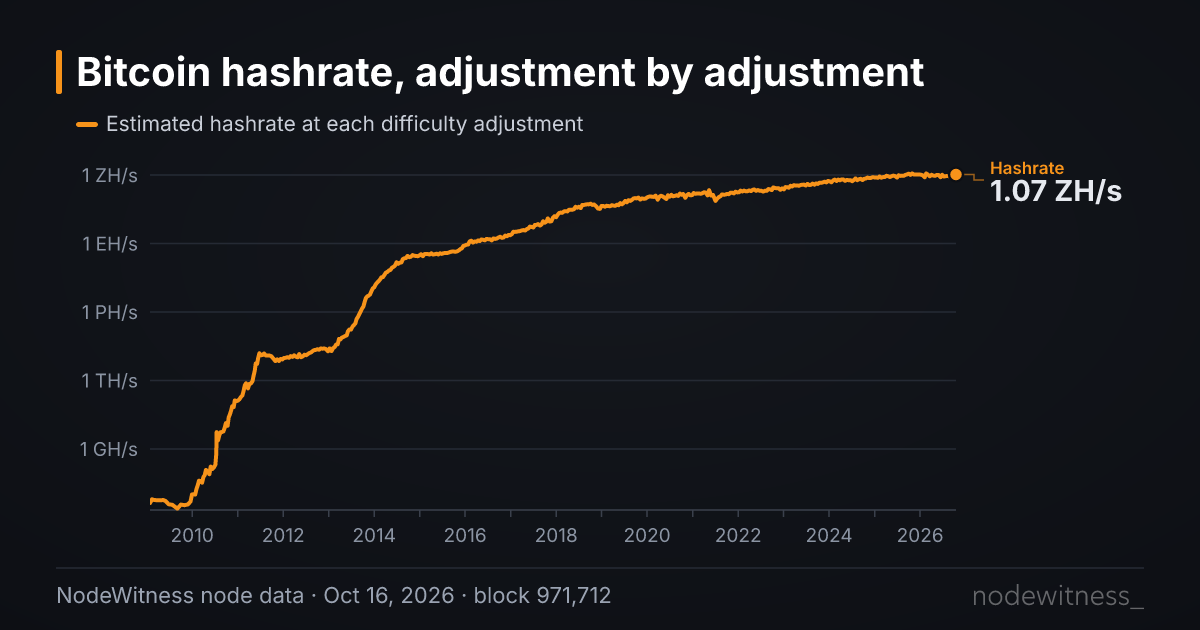
The other common way to compute hashprice is to divide the day's mining revenue by the network's hashrate. The catch is that nobody measures hashrate directly; it's always inferred, and the estimates disagree. Our node put it at 1,065 EH/s at the last retarget, the average over the previous two weeks of blocks; so far in the current epoch, with blocks arriving every 9.6 minutes on average, it estimates 1,053 EH/s [2]. Difficulty alone, assuming exactly ten-minute blocks, implies 1,006 EH/s. Rax cites CoinWarz at about 1,160 EH/s for early October [7].
Divide the same day's revenue by each and you get three different hashprices.

That spread, about $5 per PH/s per day, is a 13% disagreement produced entirely by the denominator. It's the reason we use difficulty: it's exact, everyone can check it against their own node, and it gives the expected earnings of a petahash without having to guess how many petahashes are out there. You can follow the hashrate our node estimates for each epoch on our hashrate chart.
So is half of it electricity?
Hashprice is revenue; Vitalik's table is cost. To put them side by side you need a machine's efficiency and a power price. CoinShares' second-quarter mining report gives one real pair: Bitdeer ran a 15.8 J/TH fleet at an average $44 per megawatt-hour [8]. At that efficiency, 1 PH/s draws 15.8 kW, or 379 kWh a day, which costs $16.68 at $44/MWh. Against $37.80 of revenue, that's about 44%.
The listed miners' own books land in a similar range. In the same report, electricity was $39,978 of Riot's $113,499 all-in cost per bitcoin (35%) and $36,377 of Bitdeer's $89,737 (41%) [8]. Vitalik's 46% for all electricity is a little above both, and close to our Bitdeer-style estimate.
One number in his table deserves a second look. Its rows add up to about $93,700 per bitcoin, above CoinGecko's October 21 close of $84,082 [1][9]. That's not a contradiction on its own: CoinShares puts the weighted average cash cost of listed miners at about $75,500 per bitcoin in Q2, excluding tax, and all-in costs include depreciation that doesn't come out of anyone's bank account each month [8]. Cash cost and all-in cost answer different questions.
A year ago, and in June
Counting the subsidy alone, so the comparison isn't muddied by fees, a petahash earned 0.000428 BTC a day on October 21, 2025, at a difficulty of 146.72 trillion. At CoinMarketCap's close for that day, $108,477, that was $46.48 [2][10]. Today the same petahash earns 4.4% more bitcoin but 19% fewer dollars, because difficulty has fallen while the price has fallen further.
The low point came earlier this year. CoinShares puts June's monthly average at $27.7 per PH/s per day, the lowest on record [8]. October 21's figure is 36% above that.
Difficulty, for its part, is still below its record of 155.97 trillion, set on October 29, 2025. Our node shows the same figure for that adjustment that CoinShares reports [2][8]. The network has been through a long shakeout: CoinShares counts a 27% fall in hashrate from early October 2025 to early February 2026, and tracks, company by company, listed miners moving power to AI data centers [8]. Vitalik's second table is the contrast he was drawing: for AI inference, electricity is about 4% of the cost and hardware about 76% [1].
What this number doesn't tell you
- It's revenue, not profit. Hashprice is gross. Electricity, hardware, pool fees and everything else in Vitalik's table come out afterwards.
- It's an expectation, not a payout. On October 21 the network found 151 blocks instead of the 144 the difficulty targets, so miners collectively took home more than the expected figure that day [3]. Pools smooth that luck out; small solo miners don't.
- It changes every 2,016 blocks. Our node estimates the next adjustment at about +4.7% around October 29, but that estimate moves with every block [2]. Price and fees move it every day. Our live difficulty adjustment page keeps the estimate current.
- Vitalik's table has no stated source. We've used it as he presented it, alongside figures from company filings compiled by CoinShares, but it can't be checked line by line.
- Nothing here is investment advice, nor a forecast of where hashprice goes next.
Miners show up in the chain in other ways too: their blocks are how a soft fork gets signaled, as we measured block by block during BIP-110's voluntary window and in the signaling math that stalled it. For the rest of the network's numbers, from difficulty to fees, see the Network section.
Difficulty, block times and hashrate for every two-week epoch, read from our own node, are on our Bitcoin hashrate chart, free to check against yours.
Sources
Labelled by type.
- Vitalik Buterin, post on X, October 17, 2026, 07:50 CEST, with two cost tables (Bitcoin per BTC, AI inference per GPU-year). The 50/50 claim and the cost split; no source given for the tables. (Primary, statement)
- NodeWitness, difficulty at each retarget (block 971,712: 140,577,680,051,919.6, +5.92%; block 969,696: 132,716,002,350,731.3; block 919,296: 146,716,052,770,107.5; block 921,312: 155,973,032,196,071.9), epoch hashrate estimates, current-epoch estimate (1,053 EH/s) and next-adjustment estimate (+4.7%, block 973,728) from our own node, read October 22, 2026 at block 972,587, on the difficulty adjustment page. (Primary, own data)
- mempool.space, block data for the 151 blocks mined on October 21, 2026 UTC (972,396 to 972,546), accessed October 22, 2026. Fees per block. (Primary, public chain record)
- Cloudmine Crypto, open daily hashprice data, accessed October 22, 2026. 0.00044956 BTC per PH/s and a 0.53% fee share for October 21. (Secondary, data aggregator)
- Startmining, Bitcoin network dashboard, accessed October 22, 2026. $36.99 per PH/s per day. (Secondary, data aggregator)
- Firsthand Bitcoin, Hashprice: daily chart and data, accessed October 19 and 22, 2026. $39 per PH/s per day on October 18 and $38 as of October 21, from a mining pool's published series. (Secondary, data aggregator)
- Rax, Bitcoin Mining Market October 2026, October 2026. About $40 per PH/s per day and about 1,160 EH/s (CoinWarz) in early October. A hosting company with a commercial interest in the topic. (Secondary, industry report)
- CoinShares, Bitcoin mining report, Q2 2026, accessed October 19, 2026. June's $27.7 average hashprice, listed miners' cash cost, Bitdeer's efficiency and power price, Riot's and Bitdeer's cost breakdowns, the 155.97T record. (Secondary, research report built on company filings)
- CoinGecko, Bitcoin price history, accessed October 23, 2026. Daily close of $84,082 for October 21, 2026 (dates in UTC) and $82,020 for October 18. (Secondary, price aggregator)
- CoinMarketCap, Bitcoin historical data, accessed October 23, 2026. Close of $108,476.89 for October 21, 2025 (UTC), beyond the one year CoinGecko shows publicly. (Secondary, price aggregator)
More in Network and mining


Last updated: October 23, 2026