
BIP-110's voluntary period was already decided on August 1. We measured it block by block.
On August 1, 2026, BIP-110's voluntary signaling period lost any arithmetic path to its threshold, regardless of what the rest of the network did afterwards. We know because we read the version bits block by block off our own node, not because a monitor told us.
Update, August 8, 2026: the voluntary period has closed. It reached block 961,631 with 51 of 2,016 blocks signaling (2.53%), well short of the 55% required, closing slightly earlier than the "around August 9" we estimated when this was first written. The mandatory window (961,632-963,647) opened right after; the final breakdown is below.
BIP-110's mandatory signaling window opened at block 961,632. Before it did, it was worth understanding what happened in the period before it — and there is a specific date there we did not see published anywhere: the day the outcome stopped being in play.
What our node says
The voluntary period spans blocks 959,616 to 961,631 — 2,016 blocks. As of August 5, 1,506 blocks have been mined and 40 of them signal in favour: 2.66%. Lock-in requires 1,109 blocks, or 55% of the period.
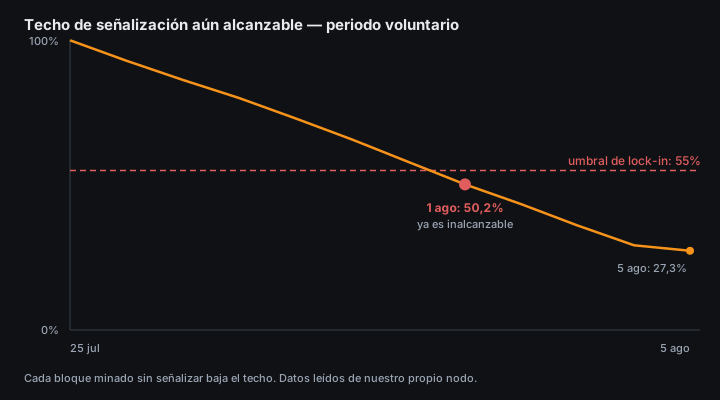
The line that matters is not the 2.66% — it is the ceiling. A block mined without signaling does not merely leave the counter unchanged: it permanently removes a chance to add to it. With 510 blocks left, even if all 510 signaled, the total would reach 550 blocks. That is 27.3%, half of what is needed.
The crossing happened on August 1, when the ceiling fell to 50.2%. From that day the voluntary period's outcome was settled, even though the period stayed open for another eight days.
| Day | Blocks mined | Signaling | Ceiling still reachable |
|---|---|---|---|
| Jul 25 | 2 | 0 | 99.9% |
| Jul 28 | 127 | 3 | 80.0% |
| Jul 30 | 153 | 8 | 65.7% |
| Jul 31 | 157 | 2 | 58.0% |
| Aug 1 | 164 | 6 | 50.2% |
| Aug 3 | 150 | 3 | 36.1% |
| Aug 5 | 41 | 2 | 27.3% |
How we measured it, so you can repeat it
For every block in the period we ask our node for its hash and its header (getblockhash, getblockheader) and read the version field. The arithmetic is what you see above: count how many signal, subtract the blocks already mined from the period total, and add the two to get the ceiling.
There is nothing proprietary in any of that. Anyone with a full node can reproduce it — which is rather the point. This is a figure you check, not one you take on faith.
Most coverage cites the public BIP110Monitor, a perfectly reasonable third-party service. Our result, reached independently, agrees with it: we measure 2.66% and the reported figure is around 2.6%. That agreement is useful for both of us.
What this figure does not say
This is where to slow down, because it is the point coverage flattens most often.
The voluntary period failing to reach lock-in does not mean BIP-110 is cancelled. The mandatory signaling window — blocks 961,632 to 963,647 — is a separate period with its own count, and activation would fall later still, at block 965,664. They are distinct mechanisms, and merging them produces wrong headlines in both directions.
Nor are we saying anything here about whether BIP-110 is a good idea. It has serious critics — Michael Saylor, Adam Back and Jameson Lopp among them have warned about chain-split risk — and supporters who see it as a necessary defence of block space. That argument is legitimate and a percentage does not settle it.
The only claim we make is verifiable arithmetic: given the blocks already mined, that particular period was not going to get there.
The final close: 2.53%, not 2.66%
The last few days of the period confirmed what the ceiling had been signaling since August 1, and the final rate came in a touch lower than what we had measured on August 5:
| Day | Blocks mined | Signaling | Ceiling still reachable |
|---|---|---|---|
| Aug 6 | 128 | 2 | 16.0% |
| Aug 7 | 158 | 7 | 8.5% |
| Aug 8 (close) | 123 | 2 | 2.5% |
Full period total: 51 of 2,016 blocks signaling, 2.53%. Against the 2.66% we had with the period half-mined (August 5), the final rate slid a little further: the last ~500 blocks signaled at an even lower rate than the rest of the period's average. Lock-in required 1,109 blocks (55%); the period fell 1,058 blocks short.
The mandatory window (blocks 961,632 to 963,647) is now open, with its own count starting from zero. If anything material changes there, we will reflect it here or in a separate follow-up.
If you run your own node and are weighing what to do, the practical part has not changed since we wrote it: it is in the node operator playbook, including the difference between doing nothing, upgrading, and switching implementation.
Would you rather check the state of the network yourself than trust a headline? On Network and mining we publish our node's status and the data we compute from it, with live block height you can cross-check against any explorer.
Last updated: August 8, 2026