
BIP-110 Is Delayed Indefinitely. The Signaling Math Killed It First.
On August 2-3, 2026, Udi Wertheimer announced BIP-110 activation was postponed indefinitely, citing the Coldcard entropy incident. The signaling numbers themselves already made the 55% lock-in threshold mathematically unreachable days before that announcement.
Two facts can both be true without contradicting each other: a real security incident can be a legitimate reason to pause a live deployment, and that deployment can already have been dead on its own numbers before the incident happened. This piece deals with the second fact only, because it's the one you can verify against public data, block by block, without having to read anyone's intentions.
Chronology
BIP-110's mandatory signaling window was fixed at block 961,632. The voluntary signaling period immediately before it — the one this piece is about — started at block 959,616 and ran through 961,631: 2,016 blocks, roughly two weeks. First signal came from Barefoot Mining via Ocean on March 1, 2026; OCEAN began signaling by default for connected miners on July 15. Every signaling period since December 2025 stayed under 1.3% support. The period in progress at the time, running roughly 2.53%, was already the strongest signaling BIP-110 had ever posted — and it still wasn't close. On August 2-3, Wertheimer announced the indefinite postponement, citing the Coldcard entropy incident (~1,816 BTC across four waves since July 30, 2026) as the reason. The standing instruction: revert to unmodified Core before block 961,632.
The Signaling Math, Block by Block
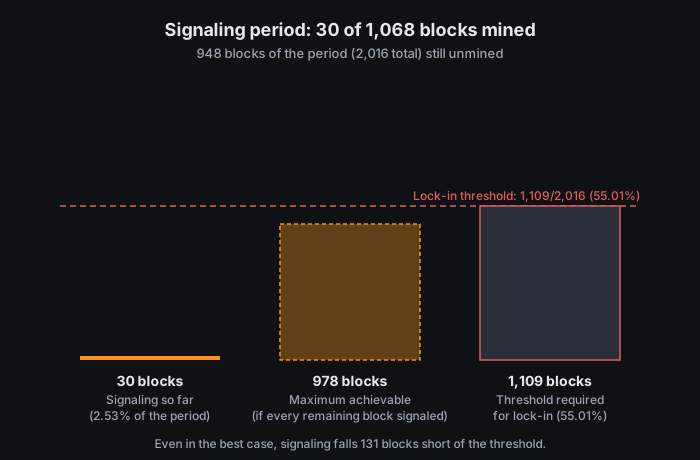
As of the announcement, the period had 1,068 of its 2,016 blocks mined. Of those, 30 carried the signal bit: 2.53-2.63%, depending on the exact snapshot cited. That left 948 blocks still to be mined in the same period.
Here's the arithmetic that doesn't need interpretation: even if all 948 remaining blocks had signaled at 100% — something that never once happened across this deployment's history — the total would have been 978 of 2,016, or 48.5%. Short of the 55.01% lock-in bar. The period was mathematically closed before it finished mining, and certainly before any postponement was announced. Michael Saylor made the same point publicly around the same time: the proposal already lacked mathematical viability, independent of any other argument about it.
A signaling bit, technically, means a block's nVersion field has its top three bits set to the pattern that marks version-bits signaling (mask 0xE0000000, value 0x20000000) AND bit 4 specifically set (0x00000010). Both conditions matter — a block that happens to have bit 4 set without the version-bits pattern isn't signaling anything, it's coincidence.
Verifying It Yourself Against Your Own Node
Every number above is independently reproducible: pull getblockheader for each block in the period, check its nVersion against the pattern above, count. No trust required in Wertheimer's announcement, in BIP110Monitor, or in us.
We did exactly that, against our own node, on August 4, 2026 — scanning every block from the start of the voluntary period (height 959,616) through the tip at scan time (height 960,977; the period itself doesn't close until 961,631, so mining was still in progress):
| Day (UTC) | Blocks mined | Signaling |
|---|---|---|
| 2026-07-25 | 2 | 0 |
| 2026-07-26 | 146 | 5 |
| 2026-07-27 | 138 | 2 |
| 2026-07-28 | 127 | 3 |
| 2026-07-29 | 143 | 0 |
| 2026-07-30 | 153 | 8 |
| 2026-07-31 | 157 | 2 |
| 2026-08-01 | 164 | 6 |
| 2026-08-02 | 144 | 6 |
| 2026-08-03 | 150 | 3 |
| 2026-08-04 | 38 | 1 |
36 of the 1,362 blocks scanned so far are signaling — 2.64%. With 654 blocks still to be mined before the period closes, the maximum achievable has dropped to 690 of 2,016, or 34.23% — below the 48.5% ceiling that was already unreachable at announcement time, simply because less of the period remains to be mined. Same conclusion as BIP110Monitor's snapshot, sourced independently from our own node, and getting more conclusive by the day, not less.
For context on why we build this kind of thing at all: it's the same standard we hold our own Cycle Score to — you don't have to trust a number we publish, you can verify it against your own node.
Why Miner Support Never Materialized
None of the majors moved. Foundry, Antpool, ViaBTC, and F2Pool hadn't signaled as of this writing; Foundry specifically pushed the decision to a hashrate-weighted client vote where non-response defaults to "No" — a structural headwind, not a neutral abstention. The activation client is a Bitcoin Knots fork, not something Core merged or shows signs of merging, which made this a UASF by construction: enforcement running from node to miner, never the reverse, and dependent entirely on miners choosing to signal with nothing forcing their hand.
Support stuck in low single digits for eight straight months isn't a data point that a single incident, however real, explains on its own.
What Node Operators Should Do Now
If you're running unmodified Bitcoin Core, nothing changes — it never required anything of you. If you installed the activation client, the standing instruction is unambiguous: revert to unmodified Core before block 961,632. Don't assume a new window with a near-term date is coming just because this one didn't complete; nothing announced suggests that yet.
Full operational detail — the seven constraints BIP-110 tightens, the one wallet edge case worth checking, what to do if a new window opens with market noise around it — is in the original playbook, unchanged except for this same update.
What This Says About How Bitcoin's Rules Actually Change
The interesting part of this case isn't that BIP-110 failed. It's that the failure was visible, public, and independently verifiable by anyone running a block explorer weeks before the official announcement — because that's exactly what the activation mechanism is built to guarantee. No group, however coordinated its client software, can lock in a consensus change without measurable, real support from the network. The design doesn't rely on trusting whoever proposes a change, or whoever calls it off — it relies on anyone being able to count the blocks.
That's the same standard behind everything we publish here: not "trust our number," but "here's how to check it yourself, against your own node or any public block explorer."
Check the current block height and a node's sync status yourself in our Network & Mining section — free, against our own node, no need to take our word for it.
Last updated: August 4, 2026