Attackers diverted 1.9 EH/s from more than 1,000 bitcoin miners without touching a machine
An attacker diverted as much as 1.9 EH/s from more than 1,000 mining sites on 20 November, without touching the machines, by announcing a fake internet route in front of unencrypted Stratum V1 connections. Against the hashrate our full node estimates, that would be 0.18% of the network. The diversion cannot be traced block by block on-chain.
On 20 November, more than 1,000 bitcoin mining sites, most of them in Europe, lost their pool connection in the same second [1]. The machines kept hashing at full power, the pool dashboard dropped to zero, and the work was credited to an impostor's account.
Braiins published its forensic report on 25 November: the attacker never broke into the farms or the pool [1]. In two weeks the diverted hashrate grew from under 175 PH/s, in Latin America, to 1.9 EH/s on 20 November [1]. Against the 1,054 EH/s our full node estimates at block 977,650 on 26 November at 07:50 UTC (08:50 Madrid time), that 1.9 EH/s would be 0.18% of the network, or one in every 555 hashes [2].
What hashrate hijacking looks like
The attacker used that trust. DNS was not touched: the miners reconnected to the same hostname and the same IP address, and a different server answered [1]. It accepted any username and password, handed out real jobs from a large public pool, and submitted the shares under its own account there [1]. "Any miner on plain Stratum V1 is a target, on any pool" [1].
Still, the rigs themselves look fine: they keep hashing and the pool shows as live. The drop is visible only on the pool dashboard [1]. Braiins concludes the attacker was not finding blocks on their own: they ran a proxy with a worker account at a large public pool [1].
A more specific route: 256 addresses inside 4,096
With BGP, routers prefer the most specific matching route [1]. On 20 November the pool's network provider was announcing a block of 4,096 addresses, a /20 prefix. Somebody announced a smaller block of 256 addresses, a /24, that included the pool's Stratum address [1]. "Somebody announced a smaller block of 256 addresses, and that block included the pool's address" [1]. Networks that accepted the announcement sent the miners' traffic to the attacker.
The forged route appeared four times that day, for spells of 6 to 49 minutes. Each time, more than 1,000 sites — 1,050 to 1,600 — lost their pool connection in the same second [1]. The owner of the address block confirmed it had never announced that route. That evening the provider blocked the network that had propagated it, and that route has not come back [1].
That said, it only worked where nobody checks announcements. Networks with RPKI rejected the forged route, and the announcement listed the real owner as its origin, so monitors that only watch for an origin change stayed quiet [1]. The first wave, from 7 to 12 November, hit Latin America, mostly Brazil and Argentina: 19 episodes of 36 to 174 PH/s, not yet confirmed in the same detail [1]. The same technique has been seen against address blocks that host the Stratum endpoints of most of the large pools, which also host thousands of unrelated services [1].
1.9 EH/s against the network's hashrate
The attacker changed method and continent. "We interpret this as testing the waters," Braiins writes [1].
Our full node cannot see those shares. It can estimate the network's hashrate from block headers. At block 977,650 on 26 November at 07:50 UTC (08:50 Madrid time), that estimate was 1,054.29 EH/s, rounded here to 1,054 EH/s [2].
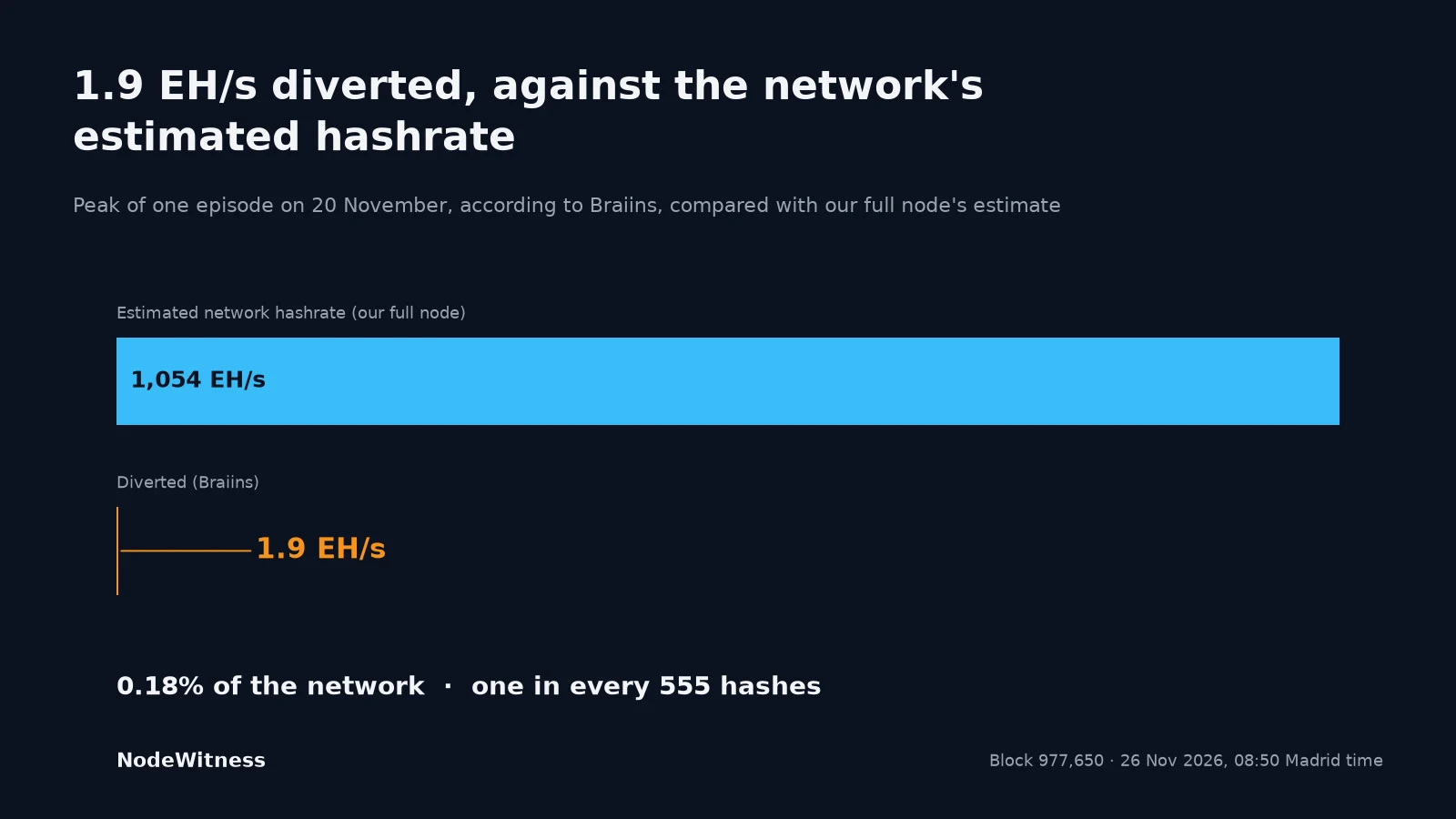
Peak of 20 November, according to Braiins, against our full node's estimate at block 977,650 (26 November 2026, 08:50 Madrid time).
1.9 EH/s would be 0.18% of that 1,054 EH/s. And still, more than 1,000 sites dropped at once.
That figure summarises the pace of blocks in the current difficulty period, which started with the 14 November adjustment. It is not the instantaneous hashrate on the 20th. That adjustment, and the return of machines that West Texas power prices had knocked offline, are in the difficulty rise due around 27 November. The previous cut is in the drop and MARA's bitcoin sales.
Why the chain does not notice
The stolen shares did not end in a ghost pool. Braiins studied a 16 November packet capture from Brazil: the fake server handed out jobs from a large public pool, with that pool's tag and payout addresses in the coinbase, and submitted the shares "under their own account". The pool where the stolen hashrate terminates "is not a part of the attack"; it is only where the attacker chose to cash in [1]. That is why the diversion cannot be traced on-chain block by block: a block with that hashrate looks like any other worker's block at the same pool.
Braiins gives no figure for what was stolen [1]. A CoinDesk calculation, using the highest hashrate and longest duration of each wave and about 453 BTC a day across 1,040 EH/s, puts the affected revenue at under $17,000 in bitcoin [3].
How to check whether your miner uses Stratum V1
Open the miner's settings, including at home or in a small shop, and read every pool URL, backups included. If any starts with stratum+tcp://, that connection is in plain text and can be hijacked [1].
The fix is Stratum V2, whose URL carries the pool's public key, or Stratum V1 over TLS on firmware that verifies the pool's certificate, with URLs that typically start with stratum2+tcp://, stratum+ssl:// or stratum+tls:// [1]. Encryption alone is not enough: Braiins tested seven firmwares on 20 and 23 November, and two widely used ones accepted invalid certificates [1]. "TLS without verification gives the miner an encrypted connection to the thief" [1].
Braiins' Connection Security page has a test of whether firmware rejects a bad certificate [6]. If the miner has neither V2 nor verified TLS, a local proxy encrypts the hop to the pool; Braiins released one on 25 November [7]. Plain-text backups should come out as well, because an attacker can break the protected connections and push the miner onto the open URL [1].
In the logs, the usual trail is a reset, a reconnect to the same hostname and IP, and a share difficulty that climbs into the hundreds of millions. Braiins says its pool never sets that difficulty above 16,777,216 [1]. Another tell is a gap between the hashrate the miner reports and the hashrate the pool dashboard credits [1]. Encryption does not stop the resets, but if the miner refuses to work for a server that cannot prove it is the pool, "The attacker does not earn any bitcoin" [1].
The 2014 precedent, and a threat that is still live
The weakness is not new: Stratum V1 has been around since 2012. On 7 August 2014, Pat Litke and Joe Stewart of Dell SecureWorks' Counter Threat Unit documented a similar routing trick: between February and May of that year, an attacker redirected miners to a pool they controlled and took an estimated $83,000 in mining rewards, in bitcoin and other coins, in a little more than four months [4]. They were already calling for TLS and server-certificate checks.
Braiins says the attack "is widespread and still a live threat" [1]. The 20 November route has not returned, but on 22 November some address blocks of other large pools were still receiving the same kind of forged announcements [1]. The Block reports that the attack remains active [5].
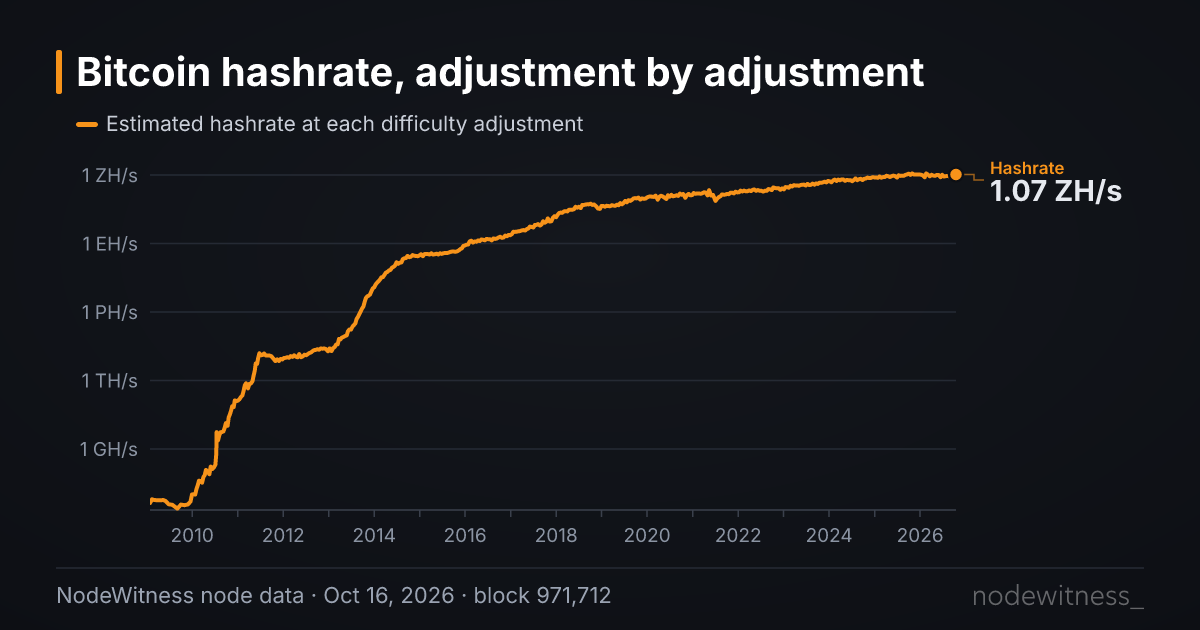
Network hashrate and the difficulty-adjustment countdown, due around 27 November, come from our full node, on the network page and the hashrate chart. What a home miner's odds look like is in our solo-mining piece.
Sources
Labelled by type. Consulted on 26 November 2026.
- Braiins, SECURITY ALERT: Bitcoin Hashrate Hijacking Detected on Stratum V1, 25 November 2026. Forensic report: the waves, site and hashrate figures, the more-specific BGP announcement, where the shares went, the recommended fixes and the statement that the attack remains a live threat. (Primary, company)
- NodeWitness, difficulty adjustment and estimated hashrate and hashrate chart, retrieved on 26 November 2026 at 09:21 Madrid time. Header of block 977,650 at 07:50:28 UTC (08:50 Madrid time). Estimated hashrate 1,054.29 EH/s; 1.9 EH/s is 0.180% of that figure, or one in every 555 hashes. (Primary, own data)
- CoinDesk, Shaurya Malwa, Over 1,000 Bitcoin miners were tricked into working for a thief by a fake internet route, 26 November 2026, updated 2:28 a.m. EST. Notes that Braiins gives no stolen amount and estimates affected revenue at under $17,000, using the highest hashrate and longest duration of each wave, and about 453 BTC a day across 1,040 EH/s. (Secondary, press)
- Pat Litke and Joe Stewart, Dell SecureWorks Counter Threat Unit, BGP Hijacking for Cryptocurrency Profit, 7 August 2014. Archived copy of the original report. Estimates $83,000 in a little more than four months, between February and May 2014, in bitcoin and other coins. The original URL no longer serves that page. (Primary, security report)
- The Block, Kyle Baird, Bitcoin miners hit by hashrate hijacking attack exploiting unencrypted connections, 25 November 2026. Reports that the attack remains active and quotes Braiins on the probing of its reach. (Secondary, press)
- Braiins Academy, Connection Security. Test of whether firmware rejects an invalid certificate. (Primary, documentation)
- Braiins, SV2 proxy, released 25 November 2026, and proxy guide. Free program to encrypt the hop to the pool when firmware cannot. (Primary, documentation)
More in Network and mining


Last updated: November 26, 2026