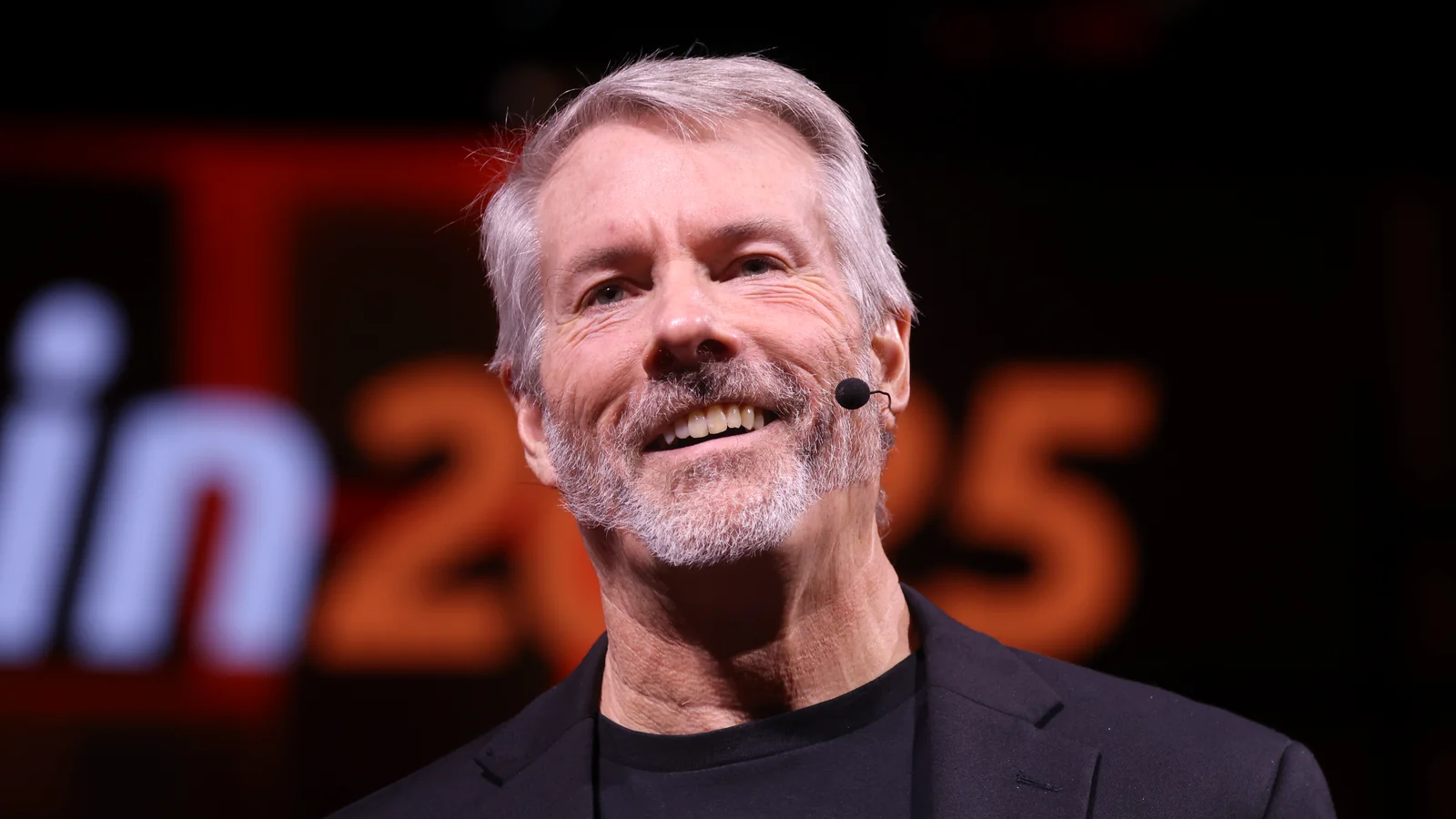
Michael Saylor, Son of an Air Force Sergeant: "After 100 Years, They Could Have Paid for One Week or Two Weeks of MIT"
Strategy's founder, whose company now holds 848,517 bitcoin, grew up in a duplex on an Air Force base in Ohio. His father woke him at 6 a.m. with a clap; his mother was the one he called when it all came apart in 2000
Michael Saylor is 61 and runs the company that owns more bitcoin than any other. On Monday, October 26, Strategy, the former MicroStrategy he founded in 1989, told the SEC it holds 848,517 bitcoin, more than 4% of all bitcoin issued, according to our supply page, bought for about $64.02 billion [1]. That stack has made him Wall Street's loudest bitcoin evangelist. His story, though, starts nowhere near a trading floor. It starts in an aluminum-sided duplex on an Air Force base in Ohio.
Long before the bitcoin, the yachts and the Bloomberg interviews, there was a boy whose father got him out of bed at six in the morning. And long before any of that mattered, on a March night in 2000, there was a 35-year-old man calling his mother to warn her that his world was about to cave in. What she said back explains Michael Saylor better than any of his numbers.
Michael Saylor, the son of an Air Force sergeant
That is how The Washington Post's Mark Leibovich reconstructed it in a four-part series published in January 2002, built on interviews with Saylor himself and more than 100 people who knew him. His father would wake him at 6 a.m. with a loud clap and yell into the bedroom: "Hit the floor running, son" [3].
Money was tight. The $50,000 ROTC scholarship that took him to MIT was worth five times his family's entire savings at the time [3]. Saylor put it in starker terms on Lex Fridman's podcast in 2022: "100 years worth of my father, my grandfather, my great-grandfather, they saved every penny they had after 100 years, they could have paid for one week or two weeks of MIT" [4].
"Mike was always the Dungeonmaster. He liked to create and control situations"
Michael Saylor's Fairborn friends: "He liked to create and control situations"
He was a quiet teenager. He spent his nights eating ice cream at Friendly's and lifting weights in the garage with his two best friends, Don Griffith and Tom Spahr, who would later work with him at MicroStrategy. They played board games and dabbled in Dungeons and Dragons. "Mike was always the Dungeonmaster," Spahr recalled, meaning the player who runs the game. "He liked to create and control situations" [3].
He played tenor sax and trombone, later taught himself guitar and piano, and graduated as valedictorian of Park Hill High School in Fairborn. Business wasn't the dream. Like a lot of kids raised in the shadow of an air base, he wanted to be a fighter pilot, until a heart murmur grounded him [3].
Michael Saylor at MIT: "A student you wouldn't forget"
When he arrived at the Massachusetts Institute of Technology in 1983, Saylor had never eaten Chinese food, owned exactly one suit (beige polyester) and wore a frizzy thin mustache. He rarely strayed beyond his fraternity, Theta Delta Chi, where he met Sanju Bansal, his roommate and later his MicroStrategy co-founder [2] [3].
John Sterman, an MIT professor, called him "always an unusual fellow, far more serious than most at MIT" and "a student you wouldn't forget." For one class project he built a computer simulation that applied the ideas of Plato's Republic to an ideal civilization. His undergraduate thesis, inspired by Machiavelli, simulated how different systems of government would react to famine, plague and war. He graduated with highest honors, with degrees in aeronautics and astronautics and in science, technology and society [3].
After two years at DuPont, he talked his boss into a $250,000 consulting contract and used it to start MicroStrategy with Bansal in 1989 [3].
The day Michael Saylor lost $6.1 billion
On February 4, 2000, with MicroStrategy shares at $142, Saylor threw himself a 35th birthday party at a fashionable Washington restaurant. The invitation read: "Guess who's old enough to run for president?" He was kidding. Or seemed to be. A few weeks later, flying home from San Francisco at the end of a roadshow, everything still looked perfect. "I'm at the top of the world, everybody loves me," he would recall [3].
But he was keeping a secret. The company's auditor, PricewaterhouseCoopers, had questioned its accounting, and MicroStrategy was going to have to restate two years of results. As midnight approached on March 19, he called his family to warn them. He spoke longest with his mother, Phyllis Saylor, the dominant figure in his life, whom friends said he credited with the belief that he could "do great and enormous things." "There's gonna be a lot of bad publicity," he told her. "People will write bad things about me." She didn't hesitate: "I loved you when you were a paper boy and a $30,000-a-year engineer. And I'll love you just as much tomorrow" [5].
Phyllis Saylor, to her son: "I loved you when you were a paper boy and a $30,000-a-year engineer"
The next day, March 20, the stock lost 62% of its value, falling from $226.75 to $86.75 [5]. At 4:01 p.m., a stock alert came through on Saylor's pager: "Hello, Michael. Your portfolio is down $6.1 billion" [5]. Then came the calls from shareholders telling him to "burn in hell" and, years later, a Trivial Pursuit card with his name as the answer [6]. "I don't think that the trauma or stress I felt is any worse than the stress that a father feels when his son has leukemia," he said in 2001. "In my case, it was my company catching leukemia" [3].
The night before he appeared before the SEC in November 2000, he went home early. He called his mother, sat down at the piano and played Beethoven's Moonlight Sonata [7]. He eventually settled without admitting wrongdoing, paying a $350,000 fine and disgorging $8.3 million [2] [7]. "It's the story of Icarus and Daedalus. Mike was the guy who flew too close to the sun," said Griffith, his childhood friend and a former SEC lawyer [3].
Michael Saylor, from the wreck to bitcoin
"I come from a naive, sort of a lower-middle-class family. I didn't understand the media. I didn't understand politics," Saylor said back then [7]. He didn't disappear. He stayed at the head of MicroStrategy. In 1999 he had already set up the foundation now called Saylor Academy, which offers free college courses and, by his count in 2022, had taught more than a million students [2] [4]. Twenty years after surviving the wreck, he made the call that changed everything: in August 2020 he put $250 million of the company's cash into 21,454 bitcoin [2].
He hasn't stopped since. In 2022 he stepped down as CEO to focus on the bitcoin strategy as executive chairman, and in 2025 the company renamed itself Strategy [2]. In the week of October 12 to 18 alone it bought another 267 bitcoin for $22.1 million, The Block reported [8] [9], and on October 13 he told Bloomberg, as summarized by Crypto Briefing, that bitcoin will climb back above $100,000 [10].
Single and childless, Saylor has said that before he dies he may burn the keys to his bitcoin so that no one can ever move those coins again [11] [12].
Still, the boy from Fairborn whose father woke him with a clap keeps the same recipe. He wrote it out by hand for a friend's twins, to be given to them when they turned 21, and repeated it to Lex Fridman: "Focus your energy, guard your time, train your mind, train your body, think for yourself, curate your friends, curate your environment, keep your promises, stay cheerful and constructive, and upgrade the world" [4].
Sources
Source type in parentheses.
- Strategy Inc, Form 8-K, SEC EDGAR, filed October 26, 2026. 848,517 BTC as of October 25, 2026, acquired for $64.02 billion; no purchases from October 19 to 25. (Primary, regulatory filing)
- Wikipedia, Michael J. Saylor, read October 28, 2026. Date and place of birth, MIT enrollment in 1983, SEC settlement without admitting wrongdoing, August 2020 purchase, move to executive chairman in 2022, rename to Strategy in 2025, foundation in 1999. (Secondary, collaborative encyclopedia)
- The Washington Post, Mark Leibovich, "Dot-Com Halo: The Rise and Fall of Michael Saylor," part 1: MicroStrategy's CEO Sped to the Brink, January 6, 2002 (full text in the Trinity University copy). Childhood, Fairborn friends, MIT, MicroStrategy's founding, the 2000 birthday party, and quotes from Spahr, Griffith, Sterman and Saylor. (Secondary, press)
- Lex Fridman Podcast #276, official transcript of the Michael Saylor episode, 2022. Family savings, Saylor Academy and the ten pieces of advice. (Primary, interview)
- The Washington Post, Mark Leibovich, part 2: At the Height of a Joy Ride, MicroStrategy Dives, January 7, 2002 (full text in the Trinity University copy). The call to Phyllis Saylor, the March 20, 2000 drop and the pager alert. (Secondary, press)
- Fortune, David A. Kaplan, MicroStrategy's boy king grows up, June 27, 2012. Shareholder calls and the Trivial Pursuit card. (Secondary, press)
- The Washington Post, Mark Leibovich, part 3: Once Defiant, MicroStrategy Chief Contritely Faces SEC, January 8, 2002 (full text in the Trinity University copy). The night before the SEC appearance, the fine and disgorgement, and the quote about his family. (Secondary, press)
- The Block, James Hunt, 'We found room for more orange': Michael Saylor's Strategy buys another 267 bitcoin for $22 million, October 19, 2026. (Secondary, press)
- Strategy Inc, Form 8-K, SEC EDGAR, filed October 19, 2026. 267 BTC for $22.1 million from October 12 to 18, 2026. (Primary, regulatory filing)
- Crypto Briefing, Vivian Nguyen, Michael Saylor says Bitcoin's slump is over and predicts a return above $100,000, October 13, 2026. Paraphrase of Saylor's October 13 Bloomberg remarks, no direct quote; Bloomberg's own story is paywalled. (Secondary, press)
- The New Zealand Herald, Markets with Madison, The Bitcoin revolution & risks with Michael Saylor (Part Two), October 20, 2024, at 58:37. "I'm a single guy. I have no children." (Primary, interview)
- CoinDesk, Christine Lee, Michael Saylor's $200T Strategy: U.S. Bitcoin Strategic Reserve & Immortality, March 25, 2025. His plan to burn his keys before he dies. (Secondary, press interview)
More in Supply and holders


Last updated: October 29, 2026