
How many bitcoin exist? Our node counts 230.12 fewer than were issued
Most answers to "how many bitcoin are there" round to a number from a price site. Here is the exact count from our own node, the exact number the rules say should exist, and the 230.12 BTC gap between them, accounted for down to the satoshi up to 2020.
Every week we snapshot our Bitcoin node's full unspent-output set, 165.1 million outputs in the latest one (October 4, 2026). Adding them up gives the bitcoin that actually exists. Comparing that with the issuance schedule is one of the simplest audits anyone can run on Bitcoin.
The count
| Block 969,785 (4 Oct 2026) | BTC |
|---|---|
| Issued under the schedule | 20,093,081.25 |
| Counted by our node | 20,092,851.13 |
| Gap | −230.12 |
The schedule is 50 BTC per block, halved every 210,000 blocks, exactly as written in Bitcoin Core's block subsidy function [1]. The gap is 0.00115% of supply, and none of it is rounding.
Where the 230.12 BTC went
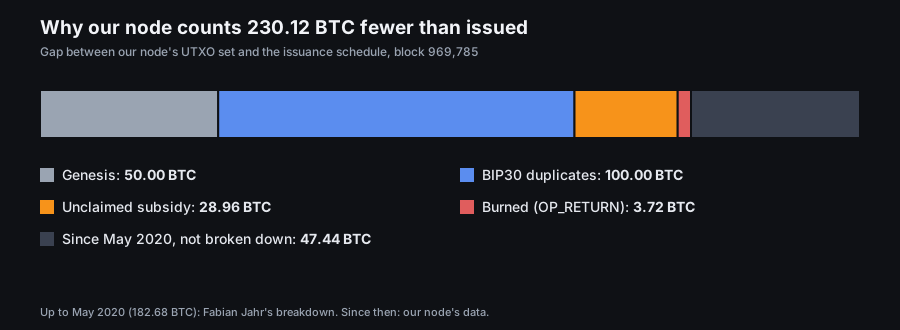
In May 2020, Bitcoin Core developer Fabian Jahr broke down the 182.68 BTC gap of the time [2]. Our node's May 2020 snapshot shows exactly −182.68 BTC. Two independent calculations, same result to the satoshi:
- 50 BTC, genesis block. The first block's reward never entered the spendable coin database [2][3].
- 100 BTC, duplicate coinbases. In 2010, blocks 91,842 and 91,880 repeated the coinbase transactions of blocks 91,812 and 91,722, overwriting them. Spotted in 2011 [4] and ruled out going forward by BIP30 [5].
- 28.96 BTC, unclaimed subsidy. Miners who paid themselves less than allowed. The rest is never created.
- 3.72 BTC, OP_RETURN burns. Outputs marked unspendable on purpose.
Another 47.44 BTC has gone missing since May 2020, most plausibly through the last two causes. We have not broken it down yet, so we do not claim it. What our series does show is that it arrived in discrete jumps; the largest, 9 BTC, between blocks 910,512 and 911,520 in August 2025.
A number that can only grow
Across 452 weekly snapshots since January 2018, the gap has always been negative and has never shrunk: −176.41 BTC in 2018, −182.68 in 2020, −230.12 today. Burned or unclaimed coins cannot come back. And if bitcoin were ever created outside the schedule, by a bug or anything else, the count would exceed the schedule and the gap would flip positive. It never has.
We publish this check weekly in the supply section and alongside our HODL waves chart.
What it does not measure
Coins lost to forgotten keys are not in this number: they are still unspent outputs, so the node still counts them. Those losses are far larger but impossible to separate from coins that are simply held. If you want yours to avoid that fate, see our inheritance planning guide. The 21 million cap is unaffected: 95.7% has been issued, and the 96% countdown tracks the next milestone.
To audit it yourself, run gettxoutsetinfo on your own Bitcoin Core node and compute the
schedule for the same height. If you get a different figure at block 969,785, one of us is wrong,
and we want to know.
Sources
Labelled by type.
- Bitcoin Core,
GetBlockSubsidyinvalidation.cpp. (Primary, reference code) - Fabian Jahr, "Where are the coins?", 8 May 2020, republished on Bitcoin Words. (Secondary to the code: analysis by a Bitcoin Core developer, which our own data matches to the satoshi)
- Bitcoin Wiki, "Genesis block". (Secondary, community wiki; low weight, corroborates [2])
- Bitcoin Core, issue #612, "duplicate coinbase transactions are allowed", 7 Nov 2011. (Primary, historical record)
- BIP30. (Primary, specification)
- NodeWitness, weekly UTXO-set count from our own node, 452 snapshots since 12 Jan 2018. (Primary, own data)
Follow Bitcoin supply verified from our own node, free and without sign-up, in the supply section.
More in Supply and holders



Last updated: October 8, 2026