Sats to USD: How Satoshis Convert to Dollars, With the Numbers Worked Out
A sat is one hundred-millionth of a bitcoin. Turning it into dollars takes one division, and the result moves every time the price does.
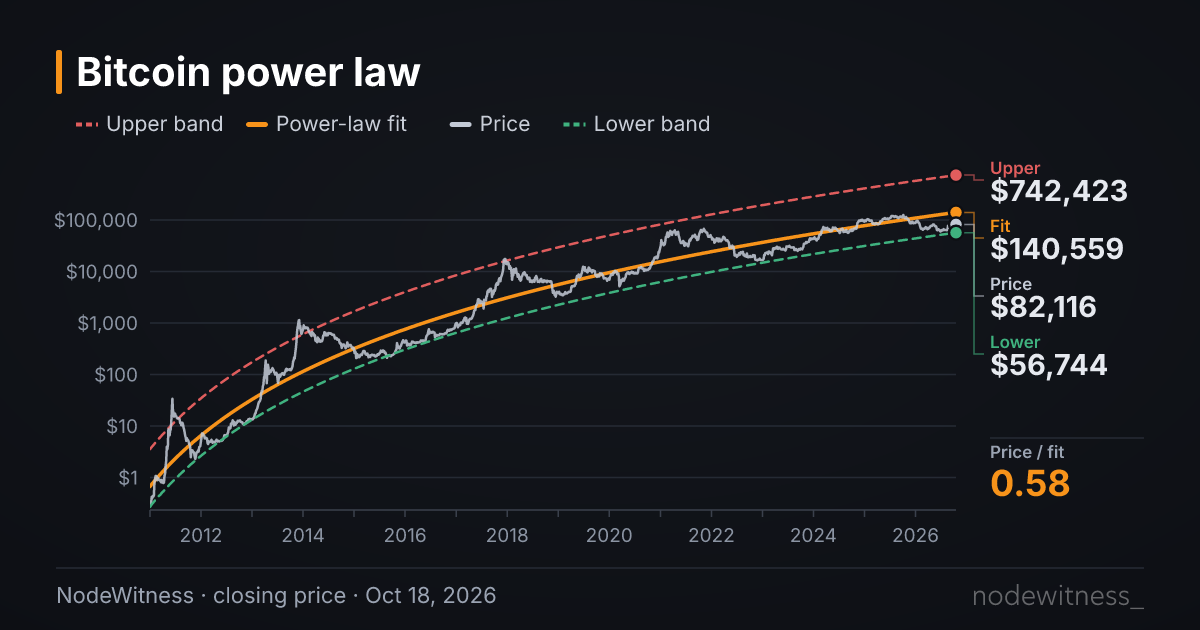
The short answer: one bitcoin is 100,000,000 sats [1], so the dollar value of one sat is the bitcoin price divided by 100 million. At the October 18, 2026 daily close of $82,116, one sat was worth $0.00082116 and one dollar bought about 1,218 sats, according to our price series [5]. For the live figure, our sats to USD converter recalculates every hour.
The questions below are the ones people search most around satoshis and dollars. Every number is worked from our own daily closes or from the Bitcoin software itself, and the rest of our market coverage has the indicators behind the price.
One bitcoin is exactly 100,000,000 sats
The same file sets the maximum amount any single value can take, 21,000,000 coins, as a sanity bound [1]. The real supply sits just under it. Our node counted 20,099,554.25 BTC issued at block 971,930, which is about 2.01 quadrillion sats [5].
The conversion is one division
To go from sats to dollars, multiply the sats by the price and divide by 100,000,000. To go from dollars to sats, multiply the dollars by 100,000,000 and divide by the price. At the October 18, 2026 close of $82,116 [5]:
| Sats | USD |
|---|---|
| 1 | $0.00082116 |
| 100 | $0.082 |
| 1,000 | $0.82 |
| 10,000 | $8.21 |
| 100,000 | $82.12 |
| 1,000,000 | $821.16 |
| USD | Sats |
|---|---|
| $1 | 1,218 |
| $10 | 12,178 |
| $20 | 24,356 |
| $100 | 121,779 |
These are figures for one daily close. Use the converter for today's price rather than this table.
How many sats a dollar buys has swung from 801 to 87,958 since 2013
The same dollar bought very different amounts of bitcoin depending on the day. Sats per dollar at some reference closes in our series [5]:
| Date | BTC close | Sats per $1 |
|---|---|---|
| Dec 4, 2013 (record) | $1,137 | 87,958 |
| Dec 15, 2018 (cycle low) | $3,232 | 30,941 |
| Nov 8, 2021 (record) | $67,562 | 1,480 |
| Nov 21, 2022 (cycle low) | $15,760 | 6,345 |
| Oct 6, 2025 (record) | $124,777 | 801 |
| Oct 18, 2026 | $82,116 | 1,218 |
That swing is why people who buy small amounts on a schedule usually count in sats. Our guide to dollar-cost averaging explains how a fixed dollar amount buys more sats when the price falls and fewer when it rises.
The smallest amount you can send on-chain is far above one sat
You can't usefully send one sat in a normal transaction. Bitcoin Core treats an output as "dust" when it would cost more to spend than it is worth, and won't relay it by default. At the default dust relay fee of 3,000 sats per thousand virtual bytes, that threshold is 546 sats for a legacy P2PKH output and 294 sats for a native SegWit P2WPKH output [2].
At the October 18 close, 546 sats were worth about $0.45 and 294 sats about $0.24 [5]. Those are relay limits, not consensus rules: a miner can still include a smaller output if it receives one directly.
Lightning counts in thousandths of a sat
The Lightning Network tracks balances in millisatoshis, written msat, so a payment can carry a fraction of a sat inside a channel [3]. When a channel closes on-chain, the specification requires every output to be rounded down to whole sats [3], because the base chain has no smaller unit.
A bit is 100 sats, not one
BIP 176 proposed "bits" as a display unit equal to 100 sats, or one millionth of a bitcoin, to avoid long strings of decimals [4]. It never became universal, and most wallets now show amounts in sats or BTC. If a wallet shows bits, multiply by 100 to get sats before converting to dollars.
If you are converting sats because you are saving toward a long-term target, our bitcoin and retirement questions cover the rules and the price history that matter for that. For the size of the target itself, see our retirement range analysis.
Sources
- Bitcoin Core, src/consensus/amount.h, definitions of
COIN(100,000,000) andMAX_MONEY. (Primary, reference software) - Bitcoin Core, src/policy/policy.cpp and src/policy/policy.h, dust threshold and
DUST_RELAY_TX_FEE. (Primary, reference software) - Lightning Network specification, BOLT #2: Peer Protocol (
amount_msat) and BOLT #3: Transaction and Script Formats (outputs rounded down to whole satoshis). (Primary, specification) - Jimmy Song, BIP 176: Bits Denomination. (Primary, improvement proposal)
- NodeWitness, daily bitcoin closing prices to October 18, 2026, and issued supply from our own Bitcoin Core node, full, unpruned, at block 971,930, the same data behind our market coverage. (Primary, own data)
For today's figure, use the sats to USD converter, or follow the live indicators in our market coverage.
More in Price and market


Last updated: October 19, 2026