
Managing Your Bitcoin in Practice: Custody, Inheritance and Taxes in Spain
Market analysis (the NodeWitness Cycle Score, MVRV, HODL waves) helps you understand the cycle. But it says nothing about where to keep your keys, what happens if something happens to you, or what you have to declare. This section covers that other half — the practical one.
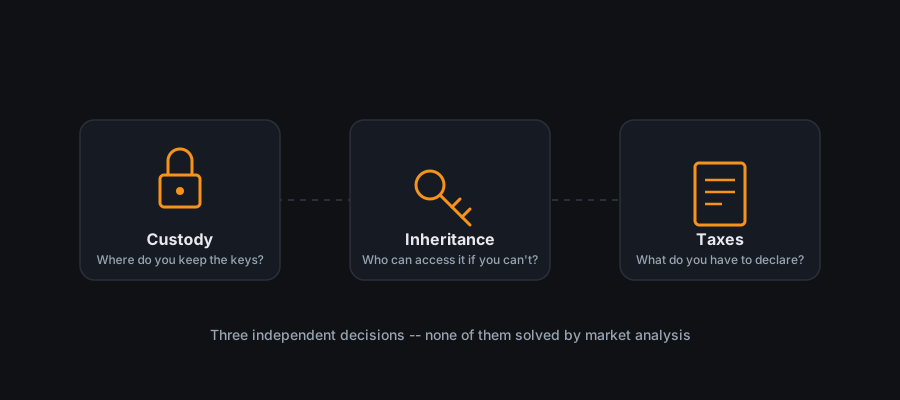
Almost all of NodeWitness answers one question: what phase of the cycle is Bitcoin in? That's a legitimate question, but it leaves out another one that's just as important and far less glamorous: once you hold Bitcoin, what do you actually do with it? Where you keep it, what happens if one day you can't access your own keys, and what obligations you take on with the tax authorities simply by holding it. This section groups the practical guides for those three questions — and each one is written for Spain's specific rules: which custody providers are actually authorized to hold Bitcoin for you there, what a Spanish will can and can't do for a private key, and what Hacienda expects you to declare. That's relevant if you're a Spain-based holder, resident or not, but if you have no ties to Spain, treat the guides as a detailed worked example — the underlying tradeoffs (custody, succession, taxation) apply everywhere; the specific rules described won't.
Why market analysis doesn't solve this
Custody: the first decision, and the one most often postponed
Where you keep your private keys determines everything else. Keeping your Bitcoin on an exchange is convenient, but it means that, technically, it isn't yours until you withdraw it — you depend on that exchange staying solvent and letting you take it out whenever you want. Holding it yourself (self-custody, with a hardware wallet or similar) removes that dependency, but shifts the entire responsibility of not losing or exposing the key onto you. Neither option is neutral, and the right choice depends on how much you hold, how much you know, and how much time you want to spend on it. If you're a resident, an expat, or otherwise hold funds through a provider based in Spain, there's a regulatory layer on top of that choice too — who's actually authorized to custody Bitcoin for you under Spanish and EU law changed substantially in 2026. The detailed guide, covering both the structural comparison and what changed, is published within this section. Running your own node is the other half of that choice, and it comes with its own question: what a change to the protocol's rules actually asks of you. The BIP-110 playbook answers it for the August 2026 window.
What actually fails without a succession plan
The most common failure isn't technical: it's that no one besides you knows those Bitcoin exist. If you die or become incapacitated without leaving any trail, your heirs have no certificate to claim anywhere — unlike a bank account, there's no institution they can write to asking for access. The funds are still there, on the blockchain, perfectly intact and perfectly unreachable, forever.
Unlike a bank account, there is no "account recovery" process in Bitcoin: without access to the private key, the funds are unrecoverable, no exceptions. This isn't a limitation of anyone's product — it's a property of the protocol, the same one that means no one can freeze or confiscate your funds without the key either. The good and bad sides of sovereignty are the same side.
Inheritance: leaving access without leaving exposure
The most common mistake when trying to fix this runs the other way: writing the seed phrase directly into the will. A will becomes an accessible document in the public registry once the succession process opens — exactly the wrong place for a private key. The real problem isn't "leaving a record that the Bitcoin exists" (that should go in the will, like any other asset), but separating that record from the actual mechanism for accessing the keys, which needs its own channel: physical redundancy across several safe locations, a multisig setup with a trusted third signer, or a specialized digital inheritance service. The full guide, walking through each technical option, is published within this same section.
Taxes: what the tax authorities already know about your Bitcoin
Bitcoin isn't invisible to tax authorities in Spain. It's part of your estate for all purposes: gains from selling it are taxable, and above certain thresholds there's an obligation to declare holdings abroad (Modelo 721). None of these obligations disappear by not looking. The dedicated tax guide covers what to declare and when — with the extra care that any figure someone might use for their own filing demands.
Saving in Bitcoin with retirement in mind
The three decisions above (custody, inheritance, taxes) all assume you already hold Bitcoin and need to manage it well. There's a prior, different question that also fits this practical section: why someone would choose to save part of their wealth in Bitcoin over the very long term, specifically with retirement in mind. Our dedicated guide contrasts how Spain's public pension system's reduction coefficients and demographics work today against what saving in an asset without that same single point of decision offers — and demands.
What you won't find in these guides
None of this is personalized legal, tax, or financial advice. What you'll find is a map of the problem and the real options that exist — whatever you decide to do about your specific case needs a real notary, lawyer, or tax advisor, not an article. We'd rather be clear about this limit than sound more useful than we are.
Before deciding how to protect, pass on, or declare your Bitcoin, it helps to know exactly what's in your addresses. You can analyze any of yours with the address analyzer.
Last updated: August 4, 2026