
We Recomputed Every Pi Cycle Top Signal From Scratch. One of Them Breaks the Legend.
"Calls the cycle top within three days" is the pitch every Pi Cycle Top writeup repeats. We ran the actual crossover against our own daily price history back to 2010, and one of the four real signals tells a noticeably different story than that pitch.
A cycle-top signal with no on-chain data at all
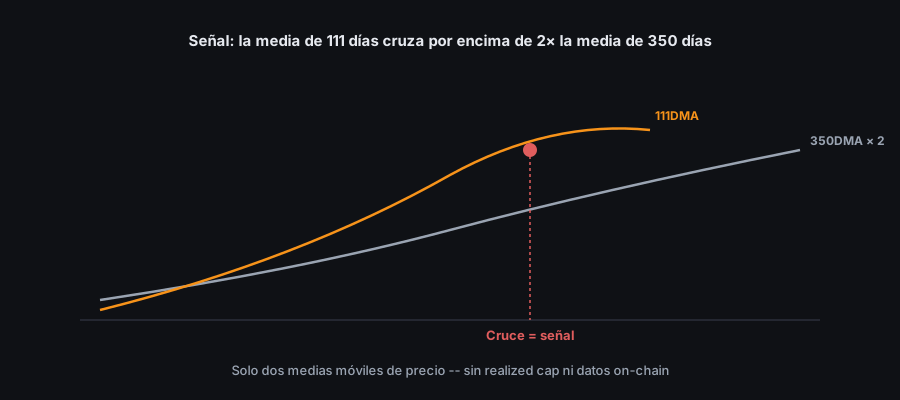
The signal fires when the 111-day average crosses above double the 350-day average. The "Pi" name comes from a numerical coincidence — that crossover, combined with the ratio between the two windows, lands close to the number pi — but that's a naming curiosity, not part of why the thing actually works.
The four real crossings, recomputed against our own history
We computed both moving averages against our own daily BTC/USD price history going back to 2010 and located every real crossover. Four showed up: April 6, 2013 (around $144), December 6, 2013 (around $800, the second top of that year's double-peak cycle), December 16, 2017 (around $19,280, landing almost exactly on that cycle's top), and April 12, 2021 (around $59,800).
The first three land almost exactly on their cycle's real top. The fourth doesn't — and that's the part the indicator's reputation usually skips.
What the legend leaves out: 2021 had two tops
Here's the nuance we verified directly and that rarely makes it into the writeup: the 2021 cycle had two tops, not one. A local top in April (around $64K), a market crash through May-July, and the real cycle top in November, near $69K. Pi Cycle Top fired on the first one, and never fired again on the second. Tracking the ratio between the two averages month by month through the rest of 2021, it dropped to 1.06 in October and only recovered to 1.15 by November, nowhere near the 2.0 needed to trigger.
This doesn't invalidate the indicator. It went three-for-three before this. And the underlying idea (price running too far ahead of its own medium-term trend) is a reasonable one. But "calls the top within three days" is a simplification that doesn't survive an honest look at what actually happened in 2021.
How to actually use it
Treat it the way you'd treat any single cycle-top signal: useful as one input among several, never sufficient on its own. That it fired cleanly in 2013 and 2017 but missed the final top of 2021 by seven months is exactly the kind of real case worth knowing before giving any single price-only metric more weight than it's earned.
Our own Score combines price with data verified from our own node, not just moving averages — check it on Cycle & Score.
Correction (October 6, 2026): the dated price figures in this article came from our own price series and were off by one day: what we stored as one day's close was the previous day's. They have been corrected. What happened is explained in the Score version history.
More in Cycle and valuation



Last updated: October 6, 2026