Seventy Candles
Wednesday, October 20, 2021
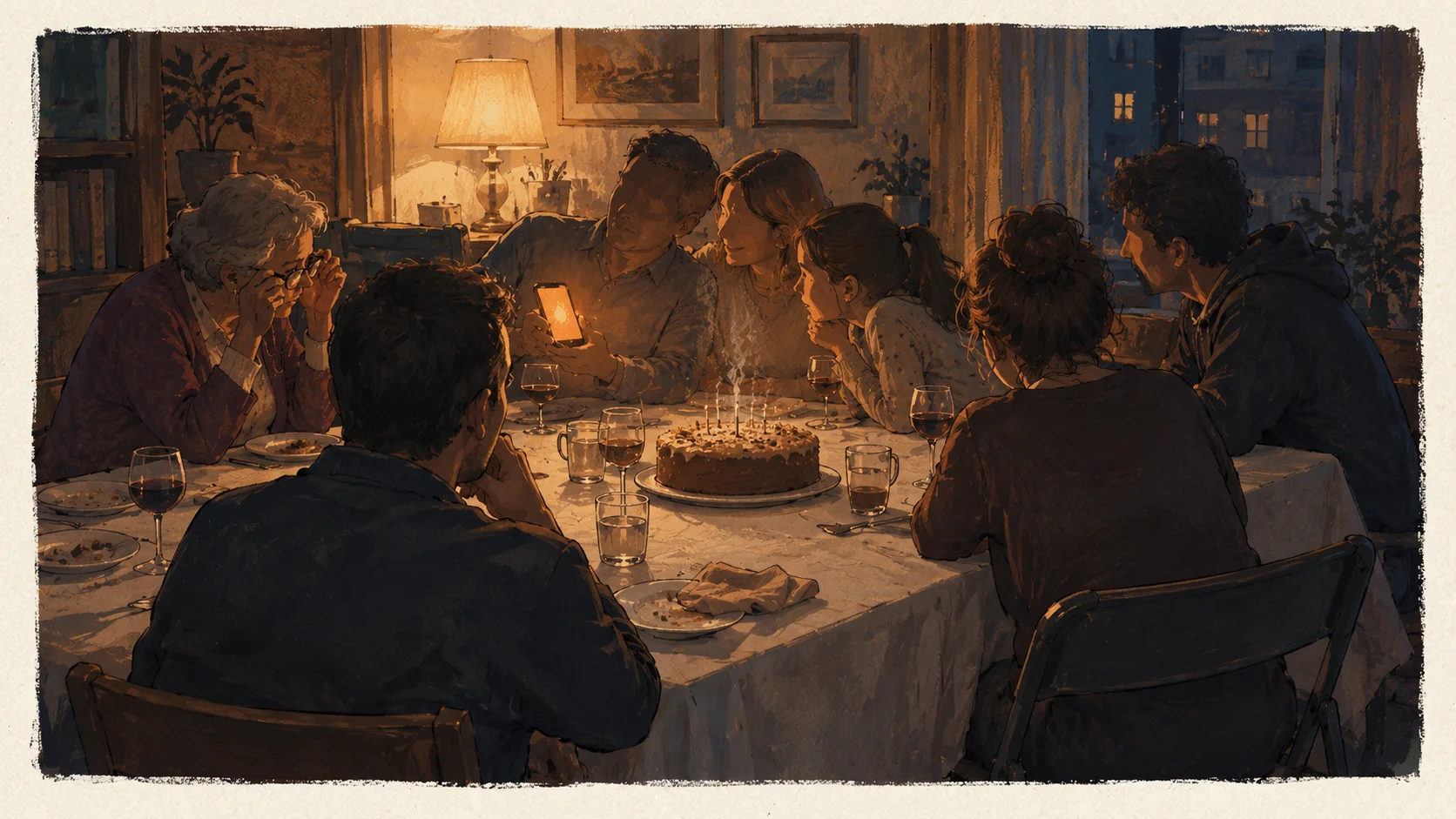
Linda turned seventy on a Wednesday and refused to move the party to the weekend, so by nine-thirty the seven of them were squeezed around her dining table in Westerville, the leaf put in, two folding chairs borrowed from the neighbors, a sheet cake from the grocery store still bristling with candles. Jake had taken the corner seat, which was where he always ended up, and from there he watched his brother-in-law reach for his phone.
He didn't look at the screen. He looked at everyone else looking at it. Linda found the reading glasses hanging around her neck, Pam gave the tired, proud smile of a wife who had heard this one before and still liked it, and even Emma, twelve and committed all evening to being bored, leaned across the table to see.
"All-time high," Kyle said. "Today."
There was a green line climbing to the right and a number, $66,064, that meant nothing to Jake. What he did know was that since August Kyle had found a way to bring bitcoin into every family meal, and that since August Jake had made a point of never asking.
"And what's that in real money?" Linda asked, because somebody had to.
"Mom, a year ago it was at eleven grand." Kyle set the phone next to his plate, screen up, so it could keep making its case. "You do the math."
"Math. I've got a shoebox of your father's savings bonds I never figured out how to cash, so don't you talk to me about money that goes up."
Everyone laughed except Dana, who looked at her mother a second too long. And Jake, with his wife's knee pressed against his under the tablecloth, which in their house meant don't, went ahead anyway.
"It's a Ponzi scheme, Kyle. I read about it. The people who got in early get paid by the people who get in late."
There was one of those pauses where you can hear the refrigerator. Kyle leaned back, grinning, like a man who'd been waiting weeks for exactly that line.
"A Ponzi. Okay. Who's at the top? Give me a name."
Jake didn't have a name. He had a feeling, and at a family dinner a feeling is worth a lot less than a phone with a green line on it.
What the phone didn't show
It was Tyler who answered from the far end of the table. Kyle's son was twenty-four, worked nights at a distribution center off I-270 and spent his breaks reading things on his phone that nobody in the family had ever asked him about.
"It was at thirty grand in July, Dad. Half. You didn't screenshot that one."
"Nothing to screenshot in July."
"That's my point." Tyler shrugged and turned to Jake. "If it were a Ponzi, somebody would be promising you a percentage, Uncle Jake. Nobody promises you anything here. It can drop by half and nobody owes you a dime."
Jake heard that as a point in his favor, so he took it.
"So it's worse. It's a casino."
"What's worse," Tyler went on, though he wasn't talking to Jake anymore, "is the other thing you're in. The three percent."
Kyle waved it away like a fly over the frosting.
"That's a different deal. It's a platform that trades bitcoin for you. Three percent a day, Tyler, a day, and I've been paid every single one for two weeks straight."
"That's not bitcoin, Dad."
"They pay me in bitcoin."
"Sure. It's still not bitcoin."
Linda asked whether anyone planned to cut the cake before the frosting slid off, and the table drifted the way tables do, to the transmission on Pam's car, Emma's new middle school, Linda's knee. Jake nodded where he was supposed to. Underneath he was still doing Kyle's math, which had lodged somewhere behind his eyes: eleven, sixty-six.
At the end of the night he offered to carry the plates to the kitchen, more to get up from the table than to help, and from the hallway he heard Linda, who had followed Kyle to the sink, talking low.
"And that three percent thing, honey... Could I get in on it?"
"We'll talk, Mom," Kyle said, and kissed her on the forehead. "Another day. No rush."
Jake walked in with the stack of plates and they both went quiet at the same time.
The drive home
"You didn't have to call my brother a fraud in front of our mother," Dana said at the first red light, without looking at him.
"I didn't call him a fraud. I called it a Ponzi."
"Jake."
Emma was asleep in the back, or doing a very good impression of it. Jake drove slowly down an empty Route 161, the wipers giving the odd swipe at a rain that never quite arrived, and thought about three percent. He made a decent living, paid $1,150 a month on the mortgage, and they had a little under $12,000 in savings for the furnace, the car, whatever broke next. Dana called it the cushion. Three percent a day on that was more than three hundred dollars, and every day.
He didn't say it out loud. It sounded too stupid to say, and he'd said plenty for one night.
After midnight
Dana went up at eleven-thirty because she had the early shift in the ER. Jake stayed on the couch with the TV off and his phone in his hand, and the first thing he did was check the price, which was still there, still above sixty-six thousand. Underneath was a gauge he'd never noticed, a number from zero to a hundred measuring fear and greed. It read 82, extreme greed. He found it faintly funny that someone had bothered to measure that.
Then he typed, slowly, the way you'd type a symptom into a search bar at midnight: is bitcoin a ponzi scheme.
He read for close to forty minutes, first on a forum where somebody called HODLer_Mike swore this was the future of money, then on a second one, uglier, where a guy with a flag avatar said the exact opposite with the exact same spelling. In one thread a third man said he'd bought in April, at the previous top, and had been a day away from selling everything in July; the replies helpfully posted screenshots of him on that same forum in July calling it over. Jake noticed he wanted to believe the first guy, and that annoyed him.
He ended up on the SEC's page about Ponzi schemes, which defined one with an almost insulting clarity: paying existing investors with money from new ones, usually with a promise of high returns and little risk. He thought about Kyle. And about the three percent, obviously, which looked a lot like that definition, whatever Tyler said.
He opened the bank app too, without really knowing why. The savings account paid 0.05% a year. He did it in his head and got about six dollars for the whole year.
But what actually kept him up was something else, and it took him a while to give it a name. His brother-in-law had watched eleven thousand turn into sixty-six thousand while Jake explained, at every Sunday lunch, why it would never last. The guy two doors down had a new truck in the driveway since September. And Mark from accounts, who couldn't set up his own voicemail, said "my bitcoin" at the coffee machine as if it were the most normal thing in the world, which Jake found hard to forgive.
If this is a scam, he thought, how come everybody's making money except me?
He didn't buy anything. He told himself so twice while brushing his teeth.
When he got to the bedroom, past one, Dana was still awake, her face lit by her phone. She locked it when she heard him and set it face down on her nightstand.
"Can't sleep?"
"Just going," she said, and turned over.
Jake didn't ask what she'd been looking at. She didn't ask him either. Once he was in bed he texted Tyler, who would be unloading trailers at that hour.
"Hey. Your dad's 3% thing. Why do you say it's not bitcoin?"
The answer came two minutes later.
"Tell you tomorrow. But don't send money to anyone who promises you a percentage. Anyone."
He was still holding the phone when it buzzed again. Kyle, apparently as wide awake as he was.
"Here's the link, bro. Use my code and you get a 10% welcome bonus. Don't sit on it though, they close spots Friday."
Jake read the two messages, one on top of the other. He didn't answer either of them. He didn't delete the second one, either.
What was real in this episode
The people in this story are made up; the world they live in isn't. On Wednesday, October 20, 2021, bitcoin closed at $66,064, its highest price ever up to that day, and the Fear & Greed Index read 82, extreme greed [2]. A year earlier it traded at $11,925; on July 20 of that same year, at $29,790. You can check every figure in our Score history for October 2021.
The definition Jake finds at midnight is the SEC's: a Ponzi scheme pays existing investors with money collected from new ones, usually promising high returns with little or no risk, and collapses once new money stops coming in [1]. Bitcoin promises no return. Platforms like Kyle's do, and the FTC is blunt about it: only scammers guarantee profits or big returns [3].
Correction (October 6, 2026): the dated price figures in this article came from our own price series and were off by one day: what we stored as one day's close was the previous day's. They have been corrected. What happened is explained in the Score version history.
Sources
- U.S. Securities and Exchange Commission, Investor.gov: Ponzi Scheme. Primary.
- Alternative.me: Crypto Fear & Greed Index, reading for October 20, 2021. Primary (the index publisher).
- Federal Trade Commission: What To Know About Cryptocurrency and Scams. Primary.
Prices are daily closes from our own BTC/USD price series.
Last updated: October 6, 2026