Thirty Business Days
Thursday, October 21, 2021, 6:10 a.m.
The diner off the I-270 exit opened at five for the night shift, and at that hour it smelled of burnt coffee, bleach and whatever had been on the griddle since midnight. Jake got there before anyone from his shift and found Tyler at the counter, still in his reflective vest from the distribution center, dragging a piece of toast through a cup of coffee that had gone cold a while ago.
"You look like you didn't sleep," Tyler said.
"You look like you unloaded three trailers."
"Four."
They ordered more coffee. Before Jake could say anything Tyler had his phone out: another record, sixty-six thousand and change, the Fear & Greed gauge at 84. He said it flatly, the way you'd read out the weather.
"My dad's thing," Tyler started, and stopped for a second to find the words. "Look. Bitcoin doesn't pay you anything, Uncle Jake. It's not a CD. You own a thing that's worth whatever someone will pay for it tomorrow, and that's it. If some platform pays you three percent every single day, that money is coming from somewhere, and the easiest place for it to come from is the next guy who signs up."
"That's what I said at dinner."
"You said it about bitcoin. You had the wrong thing."
Jake stirred his coffee harder than it needed. It bugged him that a twenty-four-year-old could explain things to him with the patience of a driving instructor, and it bugged him more that he had nothing to push back with.
"So if I want to buy some, where do I buy it?"
Tyler shrugged and talked about exchanges Jake had never heard of, about uploading your driver's license and a video of your face, about how you don't leave the coins sitting there, you move them to your own wallet later, and a lot of other things Jake lost along the way. One of them stuck.
"And don't get excited because a site says it's registered with FinCEN. That's a form. Anybody can fill out a form. The three percent guys will have one too, I bet."
What the internet said
Jake read more that week than in the previous five years put together. He read in the break room, on his lunch, in the bathroom stall at work with the door locked. In a forty-minute video a man in heavy-framed glasses explained that bitcoin would hit a million dollars, and in the next video his phone suggested, another man, in different glasses, explained with exactly the same confidence that it would go to zero. Both had hundreds of thousands of subscribers. Both sounded like they knew what they were talking about.
At the coffee machine, Mark from accounts told him he kept everything "in a really good app," and when Jake asked which one, he couldn't remember the name. He remembered how much he'd made, though.
What Jake couldn't find anywhere was someone who would tell him what was going to happen to him, to Jake Miller, with his paycheck and his mortgage, if he put money in. By Wednesday he'd figured out, without anyone telling him, that he wasn't going to find that, because nobody knew.
Friday, October 22, 12:47 a.m.
Kyle's link was still sitting in his texts, right under Tyler's. That night he opened it.
The page was slick, he had to give it that. Black background, gold lettering, a chart that climbed without a single dip and a counter in the corner showing how many people had signed up in the last twenty-four hours. Up top, in big type, three percent a day. Below, smaller, Kyle's code already filled in, and a red banner: limited spots, registration closes Friday.
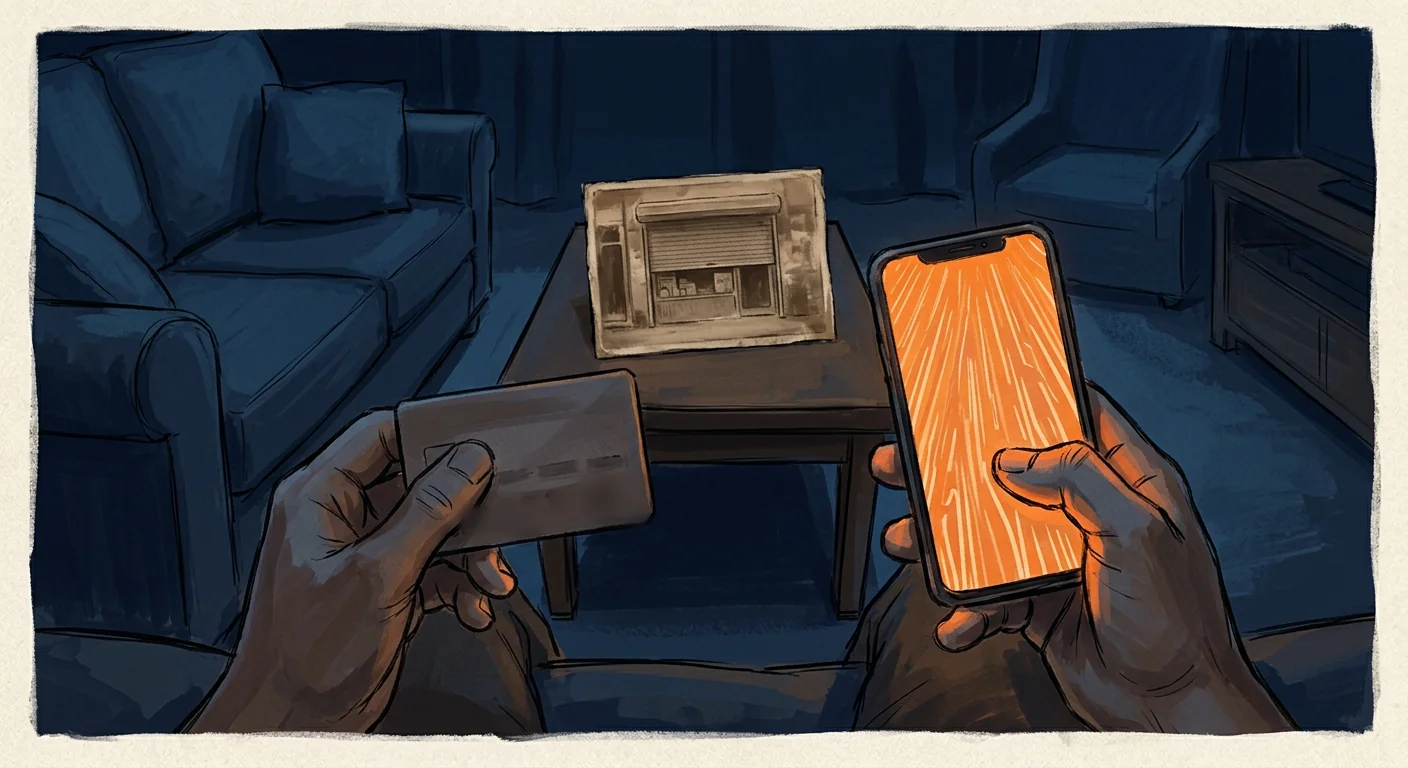
Jake typed his name, his email, his phone number. He went to the kitchen for his wallet, came back with the card in his hand and sat down on the couch again. The last step had a box to accept the terms, and out of habit, or nerves, he opened the document before checking it.
Eleven pages of strange English, like something run through a translator twice. Page three said returns were "guaranteed by the arbitrage algorithm." Page seven said withdrawals were processed "within thirty business days for security reasons." Nowhere did it give an address, a country or the name of a single human being.
And then he thought about Albright Supply.
Albright Supply had stocked his father's hardware store for twenty years. They always paid, and paid well, and when they started paying a little late in 2008 his father said they were good people, anybody can have a bad stretch. In February 2009 they stopped answering the phone. In June his father pulled the security gate down for the last time, and Jake, who was thirty and helping carry boxes out to the truck, mostly remembers that his father didn't say a word all day. Not one.
Thirty days to give you your money back, he thought. And in exchange, three percent every day.
He closed the tab without checking the box. It wasn't much of a decision, really; he just stopped wanting to, all at once. He left the card on the coffee table and it was still there in the morning when Dana found it and asked what it was doing there. Jake said he'd ordered some sneakers online. Dana didn't ask anything else.
On Saturday Kyle sent a voice message, a minute and a half long, that started with "So, bro, you in or what?" Jake didn't listen to the whole thing.
Wednesday, November 3
It took him almost two weeks to pick an exchange, and in the end he picked it by elimination more than conviction. It was a US company with a real address and named executives, it listed its money-transmitter licenses state by state, and it didn't promise any return at all. The only thing its homepage said, with no gold lettering anywhere, was that prices could go down. That made him trust it more than anything else had.
To open the account he had to upload both sides of his driver's license and a short video of his face, turning his head one way and then the other. He did it at eleven at night, locked in the bathroom, sitting on the closed lid of the toilet with the license in one hand and the phone in the other, because he didn't want to explain to anyone what he was doing. The app asked him to move closer to the light. He stood up under the vanity bulb and started over.
Halfway through the video, someone knocked.
"Jake? You okay in there? You've been a while."
"Yeah, yeah. Be right out."
He heard Dana's steps go back down the hall. He finished turning his head, left and then right, the way the screen asked, and hit submit.
The verification email came the next morning at 7:12, while he was waiting at the light on Route 161. Your account is ready. Jake read it twice. He had somewhere to buy now. What he still had to decide was whose money he'd buy with.
What was real in this episode
The characters are invented; the rules they run into aren't. Exchanges that serve US customers register with FinCEN, the Treasury's financial crimes unit, as money services businesses. Tyler's instinct holds up: in April 2024 the FBI warned that appearing on FinCEN's registrant list "is not a recommendation, certification of legitimacy, or endorsement of the business by any government agency" [1], after scammers started using their registrations as a badge of approval.
On Thursday, October 21, 2021, bitcoin closed at $62,355 with the Fear & Greed Index at 84; on Kyle's Friday deadline, at $60,697 [2]. And the FTC's line on offers like Kyle's hasn't changed: only scammers guarantee profits or big returns [3].
Correction (October 6, 2026): the dated price figures in this article came from our own price series and were off by one day: what we stored as one day's close was the previous day's. They have been corrected. What happened is explained in the Score version history.
Sources
- FBI, Internet Crime Complaint Center: Alert on Cryptocurrency Money Services Businesses, April 25, 2024. Primary.
- Alternative.me: Crypto Fear & Greed Index, readings for October 21 and 22, 2021. Primary (the index publisher).
- Federal Trade Commission: What To Know About Cryptocurrency and Scams. Primary.
Prices are daily closes from our own BTC/USD price series. Albright Supply, like every other name here, is made up.
Last updated: October 6, 2026