Sixty-Four Times
Monday, stall two
The men's room off the warehouse office had two stalls, a hand dryer that had been broken since the Fourth of July and a sign about washing up that someone had corrected in Sharpie. For fourteen years Jake had used it for the usual reasons. That week he started going in when he didn't need to, sitting down on the closed lid and opening the app.
Monday started fine. Bitcoin had closed Sunday up almost two percent, and his $3,000, which had slipped to about $2,850 by the Friday before, was back past $2,900, and he walked out of there whistling. He let a driver off the hook for being ten minutes late and caught himself humming in the oil filter aisle, and nobody on the floor knew why, and he liked that nobody knew.
That night it closed down almost three percent. He didn't whistle again.
Tuesday, the light at the gas station
The light on Route 161 by the gas station was the longest on his way to work: ninety seconds, because he'd timed it once. For years he'd spent them with sports radio and his eyes on the laundromat sign across the road. That week he spent them with the phone propped against the steering wheel, pulling the screen down with his thumb to refresh the price. On Tuesday a horn behind him let him know the light had been green for a while.
Bitcoin closed that day under $61,000, down more than five percent from the day before, and his $3,000 was worth about $2,670. He did the subtraction several times over the course of the morning and kept getting the same answer, as if one of these times it might come out different.
At lunch he texted Tyler.
"Is this normal?"
"This is a regular Tuesday for bitcoin, Uncle Jake. I don't even look at it. You check it every hour, you'll lose your mind."
Jake sent back a thumbs-up and checked it again.
Thursday, 3:10 a.m.
Dana was on nights that week, and the house felt wrong without her, too quiet in the hallway, the bed wider than it needed to be. Jake woke up at 3:10 for no reason, or so he told himself. Before he was entirely sure where he was, the phone was already in his hand and lighting up his face.
At that hour the real markets were asleep. Bitcoin never slept, though, and that was something Jake hadn't really thought about before buying. The stock market closes, the bank closes, even the diner off 270 closes for an hour on Sundays. That green-and-red line kept moving while he showered or slept, and every time he checked, something had happened without him. He spent fifteen minutes reading a thread about whether the top was in, written by people named after animals.
Then he opened his photos, watched the clips from Emma's last game, which had backed themselves up to the cloud like everything he shot, and fell asleep with the phone on his chest.
Friday, the shift meeting
The Friday meeting ran twenty minutes, and that Friday it was about Thanksgiving week, specifically who was working the day after, which in a parts distribution center is the most sensitive conversation of the year. Jake had run it for six years with a printed spreadsheet and a lot of patience.
Bitcoin had fallen another five percent and change on Thursday. He found out halfway through Friday's meeting, when his phone lit up on top of the spreadsheet with a price alert he'd switched on himself on Monday. He read the number while Ray from the forklifts explained, for the third year in a row, that his wife's family was in Toledo and he could not work Black Friday. The $3,000 was now about $2,530.
"So who's got Friday?" somebody asked.
Jake looked up and realized they were all looking at him. He had no idea who had Friday, obviously. He gave it to Ray, who hadn't asked for it, and the meeting ran ten minutes over while everyone complained.
Sunday, November 21
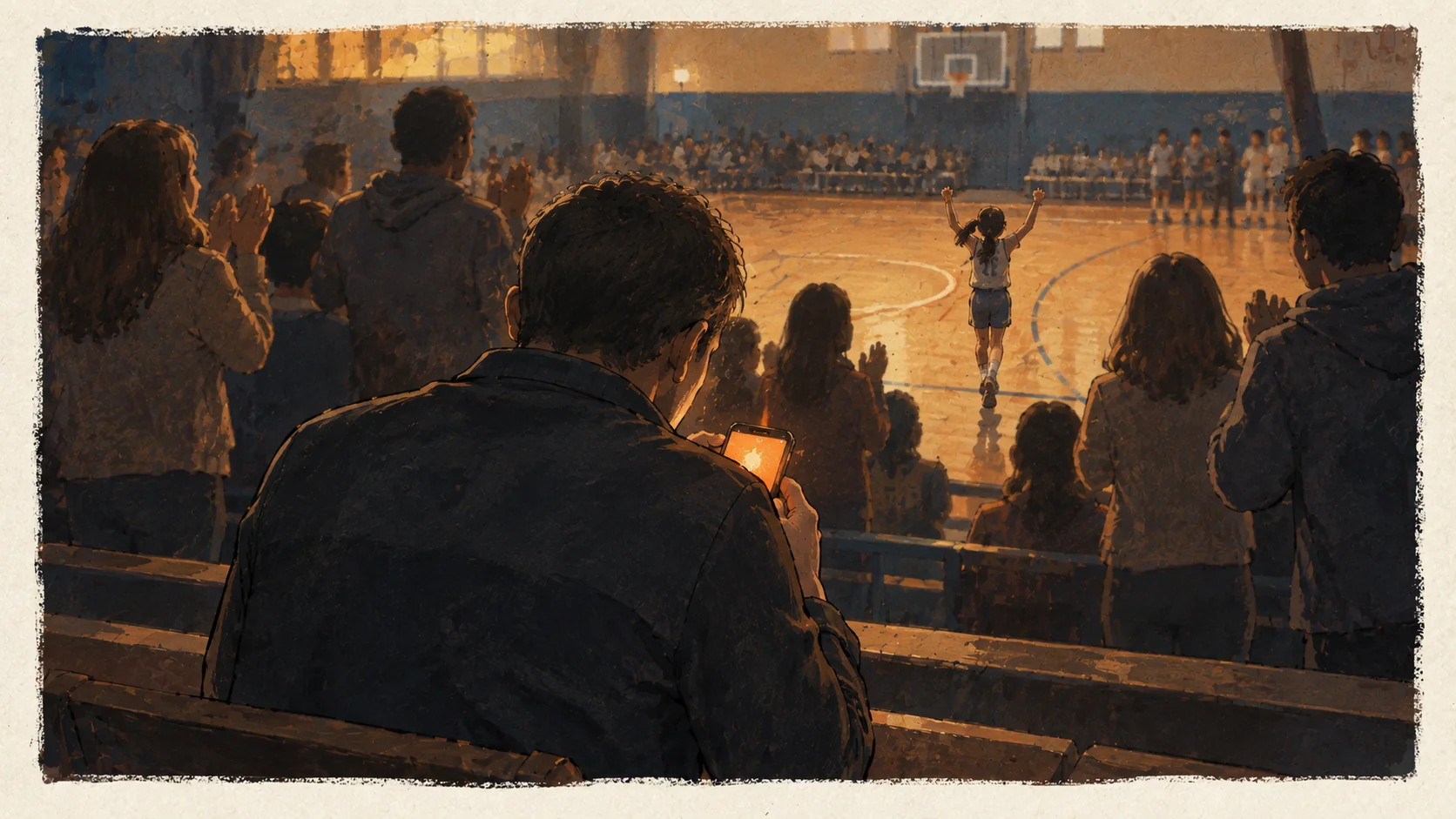
The gym at the community center smelled the way every gym in America smells, rubber and old sweat and vending machine coffee, and at five in the afternoon it was full of parents in winter coats and girls in mismatched warm-ups. Dana had come off her last night shift at seven in the morning and was still asleep when they left. Jake sat in the third row of the bleachers, right behind the bench, because Emma had asked him specifically not to sit in the first.
It was a close game. Emma played point guard, smaller than almost everyone out there, and made up for it by running more than anyone. Early in the second quarter she picked off a pass at half court. Jake saw it start, saw his daughter take off alone toward the other basket, ponytail flying.
And right then his phone buzzed in his hand.
It was the usual alert, bitcoin moving a little after a bad week, and Jake glanced down for just a second to see how much. When he looked up, the whole row was on its feet cheering, and Emma was jogging back up the floor with both arms raised, scanning the third row for him.
She found him looking at his phone.
It lasted a second. Then he was up, clapping louder than anybody, giving her a thumbs-up, and she turned around and got back on defense. They lost by four.
The parking lot
Emma took forever in the locker room, like always. Jake waited in the car with the heat running and the phone in his hand, and went into the settings to turn the alert off. He ended up instead on a screen he'd never seen, one that broke down his phone use app by app in colored bars.
The bitcoin app was at the top, ahead of email and the family group chat. Underneath it said that today, a Sunday when nothing had happened, no news, no real drop, he had opened it sixty-four times. Jake stared at the number with the same face he used for the price. He didn't turn the alert off.
Then the passenger door opened and Emma climbed in with her gym bag and wet hair. Riding up front was a new privilege, and she exercised it with her sneakers on the dashboard. They drove back down an empty Sunday Route 161 with the radio off, and at the light by the gas station, the ninety-second one, he left the phone in his pocket.
"Dad," Emma said, still looking out the window.
"Yeah?"
"Did you see my layup?"
The light was still red. Jake looked at the laundromat sign.
"Yeah," he said. "Of course I saw it."
Emma didn't say anything else the rest of the way, and when they pulled into the driveway she was out of the car before he'd turned off the engine.
What was real in this episode
Jake is made up; the week he couldn't stop looking at is real. On Sunday, November 21, 2021, bitcoin closed at $58,756, 13% below its November 8 high, and the Fear & Greed Index had slid from 84, extreme greed (on the 9th), to 49, neutral [3]. In those thirteen days there were two closes down more than 5%: Tuesday the 16th (−5.4%) and Thursday the 18th (−5.7%). It wasn't an unusual stretch. Across all of 2021, by our daily closes, 73 of the 364 day-to-day changes were bigger than 5% in one direction or the other, and the average daily move, ignoring direction, was 3.2%.
What changes is how many of those moves you see. From January 1, 2013 to November 21, 2021, bitcoin closed lower than the day before on 45% of days; compare 365-day periods instead, and 22% ended below where they started. That's the history of one asset, and it says nothing about what comes next. It does describe what Jake is living through without a name for it: check every day and you see a loss almost every other day.
In 1993 Shlomo Benartzi and Richard Thaler called this myopic loss aversion [1]. They combined two ideas: losses weigh more than gains of the same size (the estimates they cite are around two to one), and people evaluate their investments often even when their goals are long term. They studied stocks and bonds, not bitcoin, and found the stock market's premium fit investors who review their portfolios about once a year. Their starting point is a bet Paul Samuelson offered a colleague: a 50% chance to win $200 and a 50% chance to lose $100. The colleague turned down one play but said he'd happily take a hundred.
The screen Jake finds is real. Android's Digital Wellbeing shows how often each app has been opened and lets you set a per-app timer; when it runs out, the app closes and its icon dims until midnight [2]. Price alerts like the one that buzzes in the bleachers are switched on and off inside each exchange's own app.
Sources
- Shlomo Benartzi and Richard H. Thaler: Myopic Loss Aversion and the Equity Premium Puzzle, NBER Working Paper No. 4369, May 1993 (published in The Quarterly Journal of Economics in 1995). Primary.
- Google, Android Help: Manage how you spend time on your Android phone with Digital Wellbeing. Primary.
- Alternative.me: Crypto Fear & Greed Index, readings for November 9 and 21, 2021. Primary (the index publisher).
Prices, daily changes and percentages are calculated from our own daily BTC/USD closes; the numbers for those weeks are in our Score history for November 2021.
Last updated: October 11, 2026