
Your Wallet's 'Consolidate UTXOs' Button Can Undo Your Privacy in One Click
You're looking at a coin-selection screen. Two UTXOs, one labeled "Exchange A withdrawal," the other "Exchange B withdrawal," unrelated as far as anyone watching the chain can tell. You check both boxes, hit send, and the chain no longer treats them as unrelated. That single transaction is what we (and most of the privacy-tooling world) call a toxic consolidation.
Why one transaction proves common ownership
The mechanism behind it has a name: the common-input-ownership heuristic (CIOH). When a transaction spends multiple inputs, the near-universal assumption is that all of those inputs are controlled by the same party -- reliable enough that chain-analysis firms and our own clustering logic both lean on it. Cooperative multi-party signing exists (CoinJoin being the obvious example) but it's rare enough, and distinguishable enough, that CIOH holds in the vast majority of real transactions.
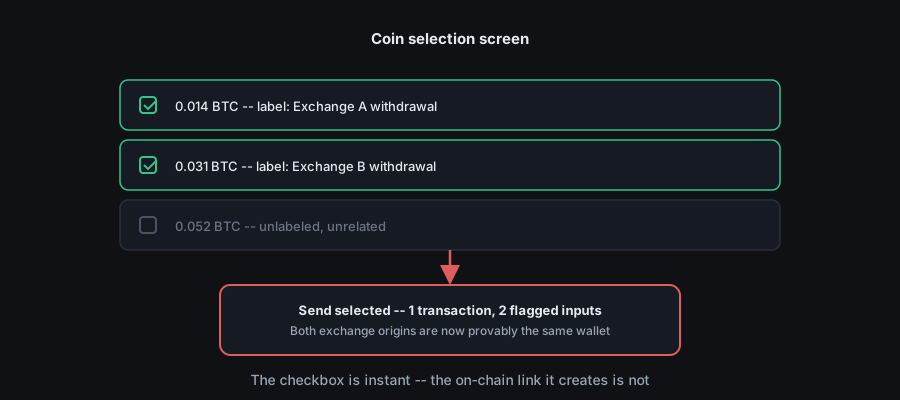
Before the consolidation, an outside observer sees two separate histories with no visible connection. The moment the transaction confirms, CIOH ties both origins into the same cluster, in public, permanently.
What our audit actually flags
We detect this exact pattern: a transaction of yours that consolidated UTXOs tainted by distinct exchanges, counting how many separate origins got merged. The penalty scales with that count: two exchanges is worse than one implied link, three or four is worse still. Same as every other flag in the report, the math isn't hidden: base weight, detection confidence, and a link straight to the transaction on mempool.space so you can verify it yourself.
When consolidating is fine
Not every consolidation is a mistake. A few cases where it changes nothing:
- Combining change outputs from your own earlier transactions
- Merging multiple payments you already know came from the same sender
- Sweeping UTXOs that were never linked to any identifiable service in the first place
The risk is specific: it's mixing origins that, until that transaction, an outside observer couldn't have connected with confidence.
Coin control: the actual fix
Coin control is the feature that solves this -- wallets like Sparrow and Electrum expose it, and if yours doesn't, that's worth weighing against whatever else it offers. It lets you pick, transaction by transaction, exactly which UTXOs go in, instead of leaving the selection to an algorithm that has no idea one input came from an exchange and another came from a stranger on the internet. The habit that matters: before you hit send, glance at what's selected. If two UTXOs need to stay unlinked, split them into two transactions -- yes, that means two network fees instead of one, and it's worth it when the origins matter.
Check whether any of your past transactions already merged separate origins with the privacy audit tool -- free, runs against our own Bitcoin node, and links directly to the transaction in question.
Last updated: 2026-07-30