
Bitcoin Address Reuse: The Privacy Mistake Exchanges Make For You
Here's the part most address-reuse explainers skip: the person reusing the address is often not the one who chose to. If an exchange hands you the same deposit address every time you fund your account, you're accumulating a public, permanent link with every single deposit -- and your own wallet hygiene has nothing to do with it.
What reuse actually exposes
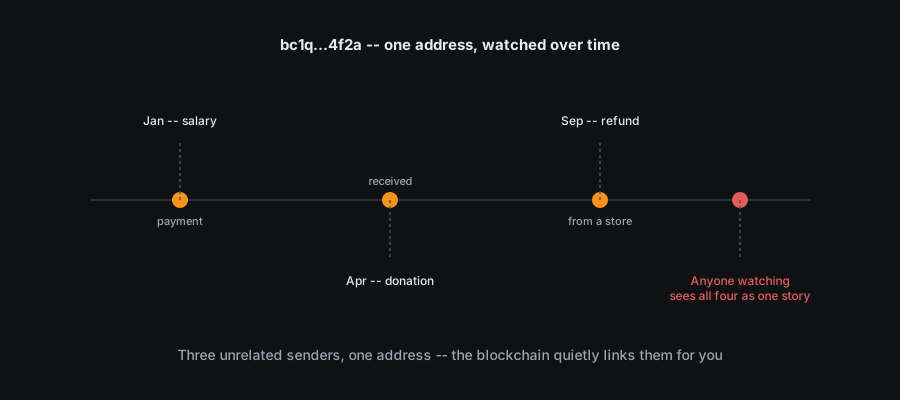
A Bitcoin address is a public mailbox. Anyone can look up how many payments it received, for how much, and when. Reuse it across unrelated senders and all of those payments show up as connected on-chain, whether the senders know each other or not. Identify the sender behind just one of those payments, and the rest inherit that identity by default.
The exchange deposit address problem
The exact pattern our tool penalizes: an address of yours that received funds from the same exchange more than once. This one isn't necessarily a mistake you made -- plenty of exchanges assign a single fixed deposit address per user and never rotate it, so every top-up strengthens the same link automatically. The penalty in our report scales directly with how many times it happened, because that's exactly how much stronger the identification gets with each repeat.
Check your own wallet in thirty seconds
Most modern wallets already solved this. Since hierarchical-deterministic wallets (HD, defined in BIP32 and BIP44) became standard, compliant wallets generate a new, distinct address for every receive request, even though they all derive from the same seed. The check itself takes seconds:
- Request two receive addresses in a row from your wallet
- Confirm they're different
- If they're always the same, or if you've ever posted a fixed address publicly (a social profile, an invoice template, a recurring donation link), that's the spot to fix
What to do once you've found reuse
The past is fixed -- confirmed transactions stay public forever, same as with toxic consolidation. What you control is everything from here on: stop sending anything new to that address, and if the pattern traces back to an exchange with a fixed deposit address, consider moving funds out to a fresh address as soon as they land instead of letting them pile up there.
Longer term, it's worth knowing about Silent Payments, a protocol proposal built specifically for this: letting someone pay you without either side coordinating a new address each time, fixing reuse at the root instead of depending on every wallet and every user getting it right. It's not widely deployed yet and deserves its own deep dive later -- for now, the practical defense is confirming your current wallet already does the right thing.
Check whether any of your addresses has received repeat payments from the same source with the privacy audit tool, free and with no signup, against our own Bitcoin node.
Last updated: 2026-07-30